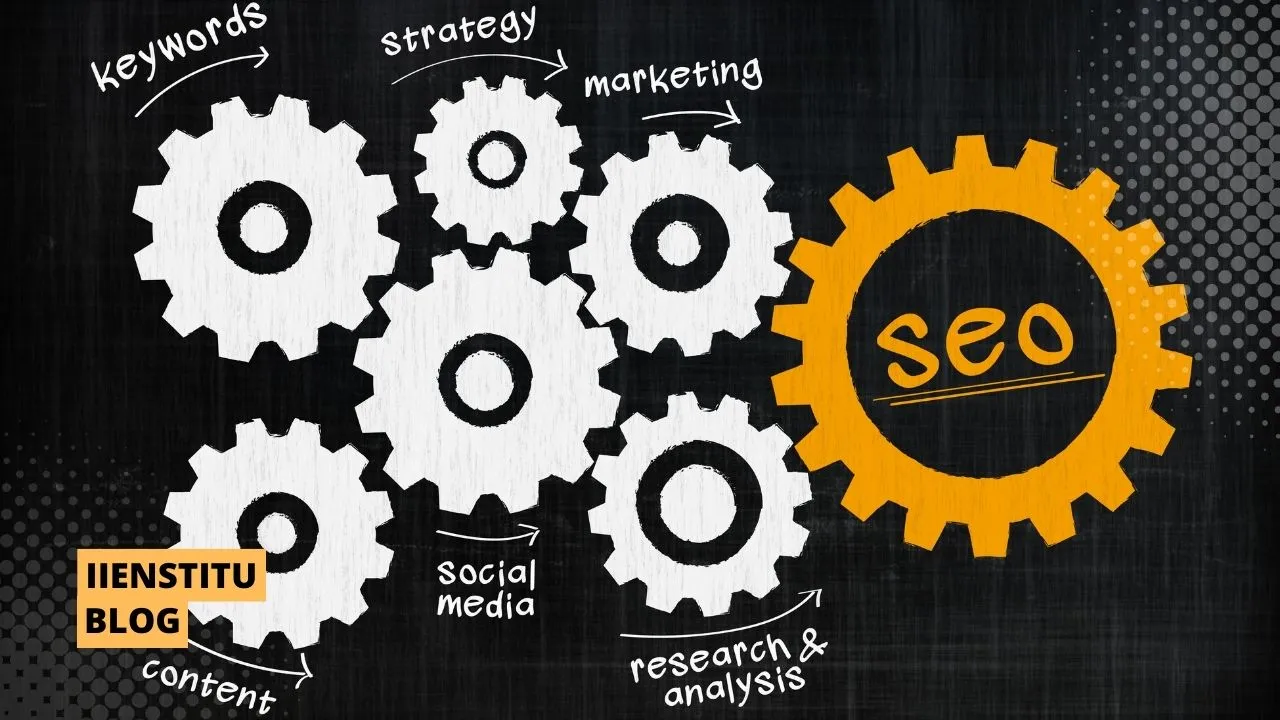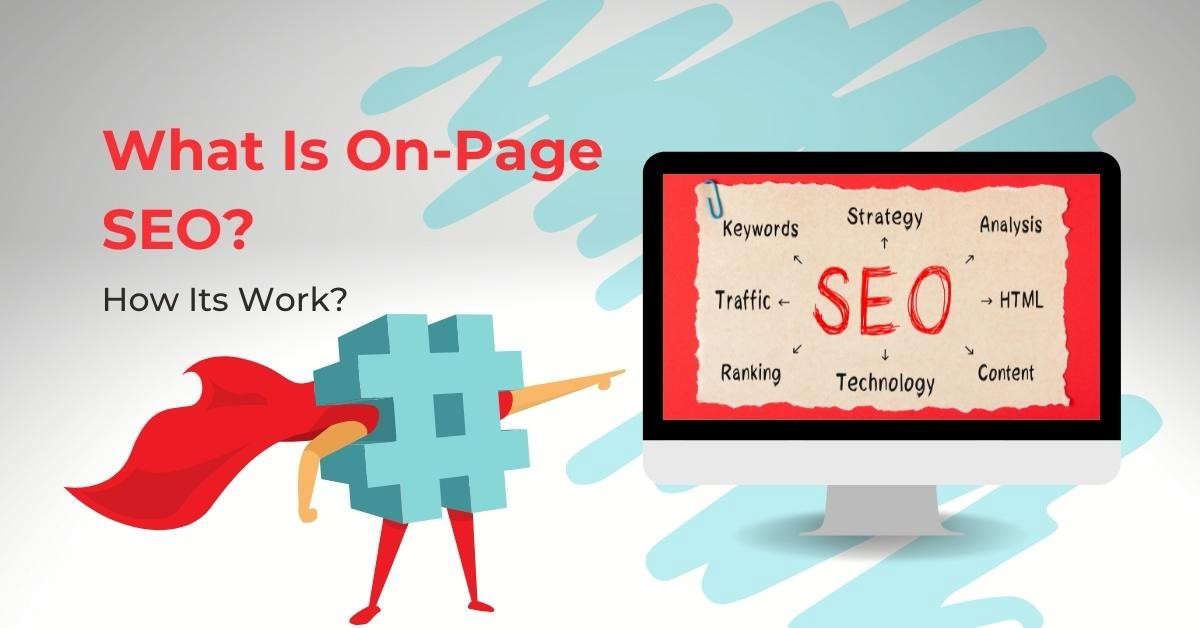
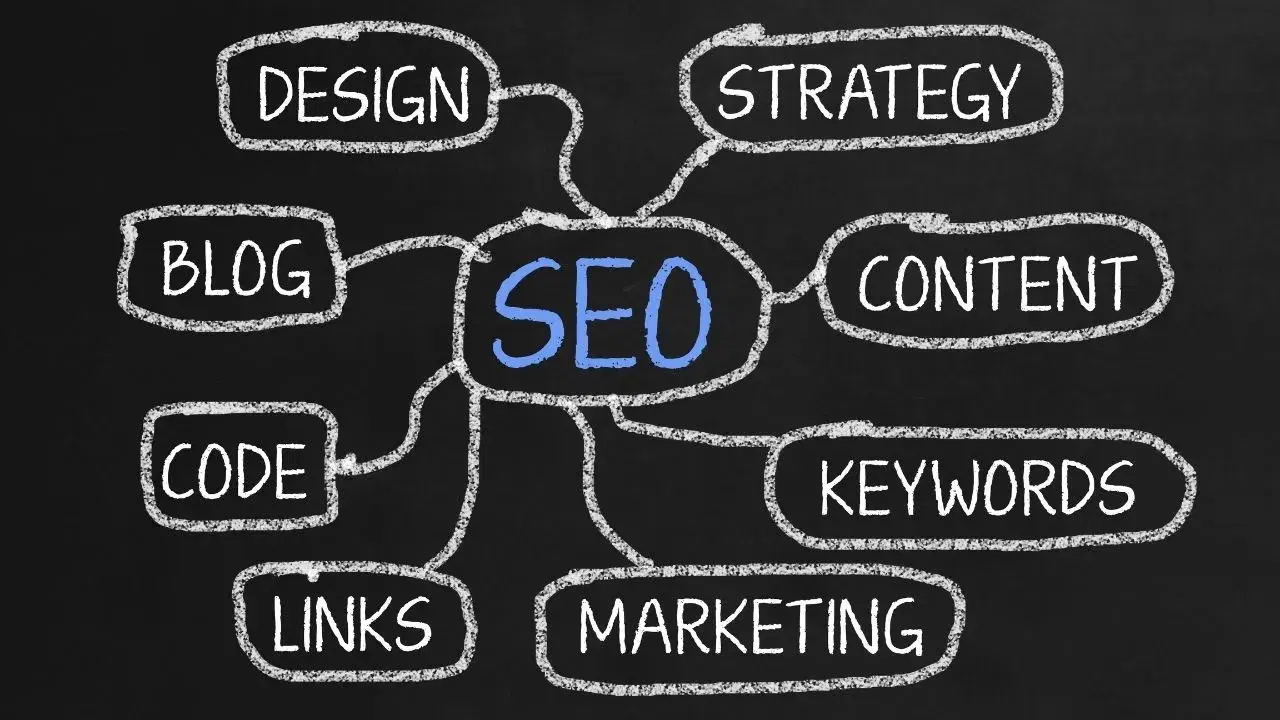
Are you looking for ways to get more traffic to your website? If so, you may want to consider organic traffic from Google. In this post, we'll discuss organic traffic and how you can increase your website's visibility in search results. We'll also provide tips for improving your website's ranking on Google. So, whether you're just getting started with SEO or looking for more advanced information, this post has something for you!
SEO is one of the essential skills that any online marketer can learn. After all, what good is a website if nobody can find it? However, SEO can be a complex and ever-changing field, making it challenging to stay up-to-date on the latest strategies. That's why it's always a good idea to invest in an SEO course. A good SEO course will teach you the basics of SEO and keep you up-to-date on the latest changes and developments. In addition, a good SEO course will also provide you with resources and support that you can use to improve your SEO skills further. So, if you're serious about marketing your website, an SEO course is an essential investment.
What is organic traffic, and why should you care about it?
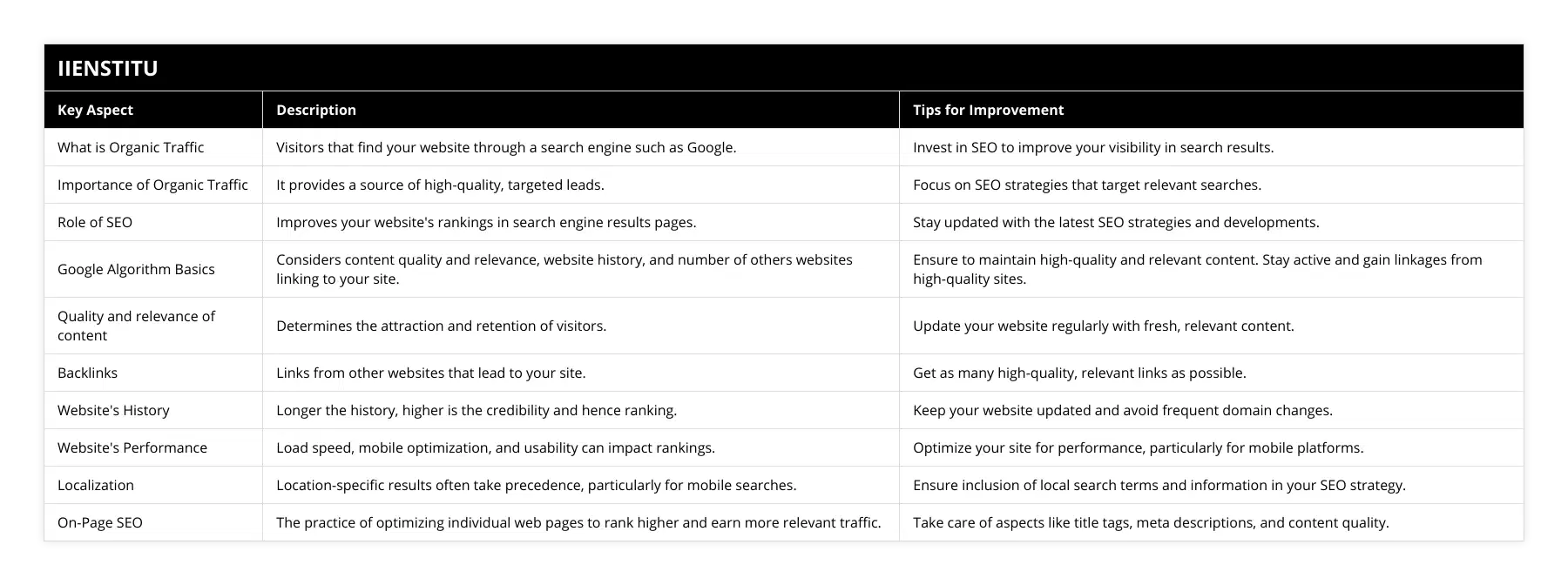
There are several ways to generate traffic to your website, but organic traffic is one of the most important. Organic traffic is the term used to describe visitors who find your website through a search engine such as Google. This type of traffic is also known as "search engine traffic."
Why is organic traffic significant? Because it represents a source of high-quality, targeted leads. In other words, when people search for something related to your business or website, they're more likely to buy from you than if they found you through a less effective marketing channel. That's why it's essential to invest time and energy into SEO.
SEO, or search engine optimization, is the process of improving your website's rankings in search engines results pages (SERPs) for relevant searches. The higher your Rankings, the more organic traffic you're likely to get. And the more organic traffic you get, the more leads and sales you're likely to generate. So, if you want to make more money from your website, it's essential to focus on organic traffic. Fortunately, there are several things you can do to improve your Rankings and increase organic traffic. Remember that it takes time and effort to see results; there's no magic bullet.
How does Google determine which websites rank highest for a given search term?
Google's search algorithm is a complex piece of software that considers several factors to determine which websites should rank highest for a given search term. Content quality and relevance are two of the most critical factors that the algorithm looks at. If your website has high-quality, relevant content, it is more likely to rank higher than a website with low-quality or irrelevant content. The algorithm also looks at your website's history. If your website has been around for a long time and has a good track record, it is more likely to rank higher than a new website with no history. Finally, the number of other websites linking to your site is also a factor. If you have many high-quality websites linking to yours, this will help your website rank higher. Google's algorithm is constantly evolving, so the specific factors that are considered can change over time. However, these three factors are always important in determining how high your website will rank.
What are the most critical factors influencing your website's ranking on Google search results pages?
Many factors can influence your website's ranking on Google search results pages. However, some of the most important include:
The quality and relevance of your website's content
The quality of your website's content is essential in attracting and retaining visitors. Relevancy is also essential, as your content needs to be timely and exciting to keep people coming back. To ensure that your website has high-quality, relevant content, you need to update and add new material regularly. This can be a challenge, but it's worth the effort to maintain a successful website. Fresh content also helps to improve your site's ranking in search engines, making it more likely that people will find your site when they're looking for information on the web. So if you want to attract and keep visitors, make sure that your website always has quality, relevant content.
The number of other websites that link to your site
In the world of SEO, links are everything. The more links you have to your website, the higher your site will rank in search engine results pages. Several factors contribute to the power of a link, including the authority of the linking site and the anchor text used. However, simply having many other websites link to your site can also be beneficial. This signals to search engines that your site is popular and relevant. As a result, if you want to boost your SEO, it's essential to focus on getting as many high-quality links as possible.
Your website's history
The geographic location of your website's users
Knowing the geographic location of your website's users can be helpful in various ways. For one thing, it can help you to tailor your content to your audience. For example, if most of your users are from the United States, you might want to focus on topics relevant to that market. Additionally, understanding the geographic distribution of your users can also be helpful from a sales and marketing perspective. For example, if you know that most of your users are located in a particular region, you can target your advertising and promotional efforts to that area. Ultimately, then, paying attention to the geographic location of your website's users can be a helpful way to understand better and serve your audience.
These factors are essential, but the content is still the king. If your website contains high-quality, relevant content, it is more likely to rank well on search results pages. This is because Google's algorithms are designed to surface the best and most relevant results for users' queries. So, if your website has excellent content relevant to what people are searching for, it is more likely to show up in search results. In addition to content quality, the number of other websites that link to your site can also influence your ranking. Google sees links as votes of confidence in your website's quality. If other websites link to yours, it tells Google that your site must be good. Finally, your website's history also plays a role in its ranking. If you have a long-standing website with a good track record, you will rank well than a new website with no history. This is because Google views established websites as more trustworthy and credible. These are just some of the most important factors influencing your website's ranking on Google search results pages. If you want to improve your ranking, you should focus on creating high-quality content and building links from other websites.
How can you improve your website's ranking in Google's search results pages for targeted keywords or phrases?
You can do several things to improve your website's ranking on Google search results pages. Some of the most effective include:
Optimizing your website's title and meta tags
How can you improve your website's ranking in Google's search results pages for specific keywords? One way is to optimize your website's title and meta tags. The title tag is the most important on-page factor for keyword ranking, so it's essential to ensure that your title tags are unique and descriptive. Meta tags are also important, as they help provide information about your website to search engines. By including relevant keywords in your title and meta tags, you can help improve your website's ranking on Google's search results pages.
Creating compelling and original content
This includes creating blog posts, articles, infographics, and even videos relevant to your target keywords. But what exactly makes content compelling and original? For starters, it should be well researched and informative. But it also needs to be engaging, interesting, and shareable. In other words, it needs to be the kind of content that people will want to read, watch, and share with their friends. So how can you create this kind of content? By being creative, thinking outside the box, and constantly trying to improve upon your previous efforts. If you can do all of those things, you'll be well on your way to creating content that will help improve your website's ranking on Google's search results pages.
Building backlinks from high-quality websites
Backlinks are links that point from one website to another, and they're a critical factor in how Google ranks websites. By building backlinks from high-quality websites, you can improve your website's ranking for specific keywords. But how do you build backlinks from high-quality websites? One way is to guest post on high-quality websites. You can also try to get featured on high-quality websites or in high-quality online directories. The more high-quality backlinks you have, the higher your website will rank on Google's search results pages. So if you're looking to improve your website's ranking, focus on building backlinks from high-quality websites.
What are some common mistakes website owners make when trying to optimize their sites for Google organic traffic?
Some common mistakes made by website owners when optimizing their sites for Google organic traffic include:
Failing to research targeted keywords or phrases
As an online business owner, ranking high in search engine results is essential for driving traffic to your website. But what you may not realize is that failing to research targeted keywords or phrases can hurt your search engine optimization (SEO) efforts. When choosing keywords, it's essential to consider how often they are searched and how difficult they are to rank for. For example, if you select too-popular keywords, you'll compete with many other websites for the top spot. On the other hand, if you choose too obscure keywords, it will be challenging to get your website to show up in any search results. The best way to find the right balance is to use keyword research tools like Google AdWords Keyword Planner and Moz Keyword Explorer. By taking the time to identify the right keywords, you can improve your chances of appearing at the top of the search results and driving more traffic to your website.
Using too many keywords on their website
If you stuff your pages with too many keywords, it will hurt your search engine rankings and turn off potential visitors. After all, no one wants to read a page crammed with keywords. Admittedly, it isn't easy to read, but it also clarifies that you are more interested in getting attention from search engines than providing valuable content. So, if you want your website to be successful, focus on using keywords judiciously and creating quality content that will appeal to both humans and search engines.
Creating low-quality or duplicate content
Creating low-quality or duplicate content is a surefire way to lose ranking on search engines. It is bad for users, who are looking for quality information, but it can also lead to search engine penalties. In addition, creating duplicate content can confuse search engines, resulting in your site being buried in the search results. If you want your site to rank well on search engines, focus on creating high-quality, original content. This content should be well researched and informative, and it should be published regularly. You can ensure that your site will be well-positioned to attract traffic and improve your search engine ranking by following these guidelines.
Building backlinks from spammy or low-quality websites
It's no secret that backlinks are among the most important ranking factors in Google's algorithm. A backlink is a vote of confidence from one website to another, and the more votes a website has, the higher it will rank in search results. However, not all backlinks are created equal. Google puts a lot of weight on high-quality websites, but links from spammy or low-quality websites can do more harm than good. That's why it's essential to be selective about the websites you choose to link to. If a website is full of low-quality content or is known for engaging in shady SEO practices, there's a good chance that link will hurt your rankings rather than help them. So, be picky about the websites you link to, and make sure they're high-quality and reputable if you want those links to benefit your SEO.
Additional resources to help you learn more about SEO and organic traffic from Google:
Google's Webmaster Guidelines
Google's Webmaster Guidelines are suggested practices for website owners and web admins who want to improve their site's ranking in Google search results. The guidelines cover various topics, including site architecture, content, links, and user experience. While there is no guarantee following the guidelines will result in higher rankings, they are a good starting point for anyone looking to improve their site's visibility on Google. And, because the policies are constantly updated to keep up with the latest changes in Google's algorithms, they provide a valuable resource for anyone who wants to stay up-to-date on the latest SEO best practices.
The Beginner's Guide to SEO from Moz
The vast array of resources available can be overwhelming if you're new to SEO. But never fear- Moz is here to help! Their "Beginner's Guide to SEO" covers everything from the basics of keyword research to more advanced topics like voice search optimization. And best of all, the guide is free! So head over to their website and start reading. Before you know it, you'll be an SEO expert!
The Advanced Guide to SEO from Moz
SEO can be a complex and ever-changing field, but thankfully there are resources like Moz that can help keep you up-to-date. The Advanced Guide to SEO from Moz covers keyword research, link building, andRankBrain. In addition, the guide provides helpful tips and advice from some of the top experts in the field. So whether you're a beginner just starting or a seasoned pro, the Advanced Guide to SEO from Moz is a valuable resource to help you stay ahead of the curve.
Even if you don’t sell anything online, it’s essential to understand how organic traffic from Google works. This is because a large percentage of web traffic comes from search engines, and the vast majority of that traffic comes from people using Google. In this post, we’ve outlined SEO basics and explained how you could improve your website’s ranking in Google’s search results pages for targeted keywords or phrases. If you want to learn more about SEO and how to increase your website’s visibility in Google’s search results, we recommend taking our free SEO course. Thanks for reading!
Frequently Asked Questions
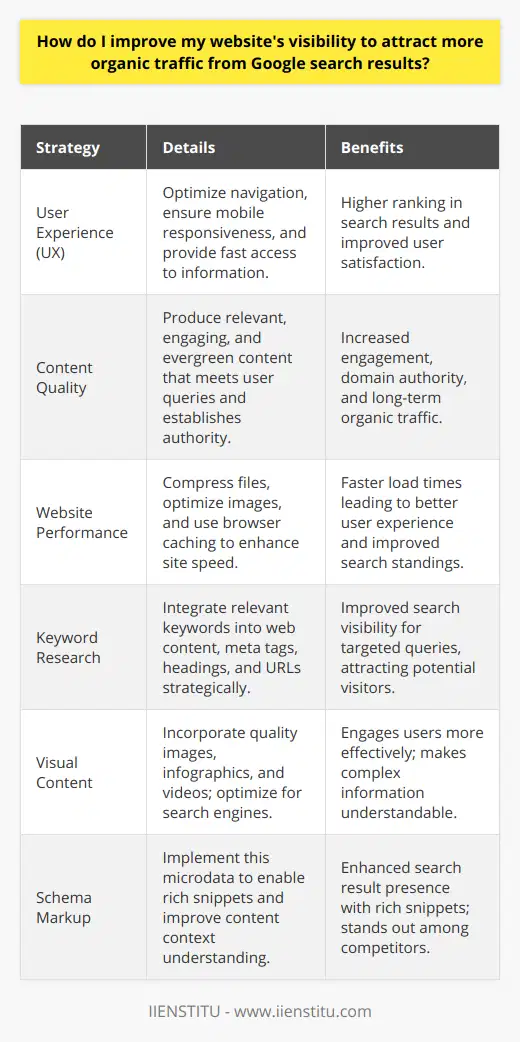
How do I improve my website's visibility to attract more organic traffic from Google search results?
Topic: Improving Website Visibility for Organic Traffic from Google Search Results
Understanding Google Algorithm
To improve a website's visibility and attract more organic traffic from Google search results, the first step is comprehending the search engine's ever-evolving algorithm. By understanding the factors that affect rankings, one can develop a strategy tailored to optimizing the site.
Focus on User Experience
A crucial factor in enhancing a website's visibility is prioritizing user experience (UX). Making the site easy to navigate, mobile-friendly, and providing valuable and engaging content keeps visitors on the page longer and increases the likelihood of Google recognizing the site as relevant.
Relevant and High-Quality Content
Content relevance and quality continue to be a significant ranking factor in Google's algorithm. Creating high-quality, engaging, and informative content that aligns with the target audience's interests encourages them to share and link to the site, boosting visibility.
Optimize Website Performance
Google uses the website's performance and page speed as ranking factors, so ensuring the site loads quickly and smoothly can significantly impact visibility. Utilizing compression, optimizing images, and reducing server response time can lead to better website performance and increased search visibility.
Keyword Research and Placement
Effective keyword research and placement are crucial for improving ranking on search engine results pages (SERPs). Identifying relevant keywords and phrases commonly searched by the target audience can be strategically incorporated into the site's content, titles, and tags to improve visibility.
Incorporate Visual Content
Visual content such as images, graphics, and videos play a vital role in enhancing a user's experience and make the content more engaging. By using appropriate visual content alongside informative text, the website can cater to a broader audience and increase the potential for sharing.
Applying Schema Markup
Schema markup helps search engines understand the content on a website and provide more accurate search results. It can significantly impact how the website appears in SERPs, increasing visibility and encouraging users to click through to the site.
Conclusion
Increasing a website's visibility in Google search results requires a comprehensive, adaptive approach to optimizing user experience, content quality, performance, keyword use, and technical elements. By focusing on these critical areas, the website can become more visible and attract a higher volume of organic traffic.
What strategies can be implemented to enhance Google organic search rankings and optimize website content?
Keyword Research and Selection
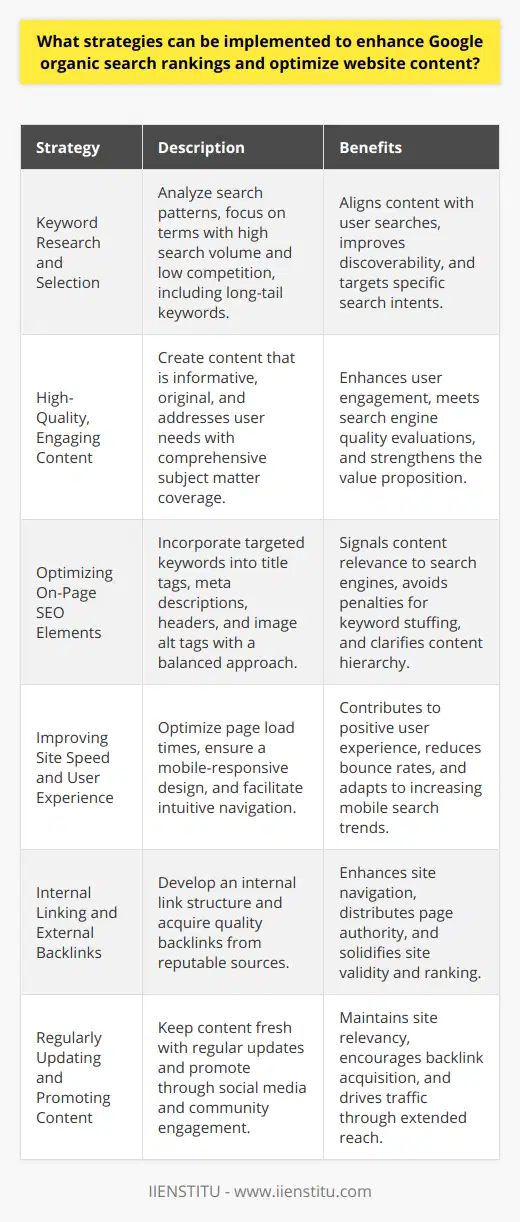
To enhance Google organic search rankings and optimize website content, webmasters must first implement an effective keyword research strategy. This involves analyzing search queries to identify relevant, high-volume, and low-competition keywords that are most likely to attract traffic and generate conversions.
High-Quality, Engaging Content
Once the desired keywords have been identified, it is crucial to create high-quality, engaging content that seamlessly incorporates these keywords. This strategy involves producing well-researched and informative articles, providing valuable insight to users and establishing the website as a reliable resource in its niche.
Optimizing On-Page SEO Elements
In addition to creating informative content, it is also imperative to optimize critical on-page SEO elements, such as title tags, meta descriptions, header tags, and image alt tags. These elements must incorporate the targeted keywords strategically, making the page more relevant and increasing the likelihood of obtaining higher search rankings.
Improving Site Speed and User Experience
Achieving optimal website performance is another crucial component of enhancing search rankings. This involves optimizing site speed to ensure that pages load quickly and efficiently, minimizing bounce rate and maximizing user engagement. Furthermore, implementing mobile-responsive designs and providing easy navigation improves user experience, which can have a positive impact on search rankings.
Internal Linking and External Backlinks
Effective linking practices can contribute to the improved rankings of a website. Developing a robust internal linking structure helps in fine-tuning the site's architecture and enhances its navigational aspects. The inclusion of relevant, high-quality external backlinks demonstrates the website's credibility, increasing the possibility of ranking higher in search results.
Regularly Updating and Promoting Content
Lastly, regularly updating and promoting website content is an essential strategy for maintaining high search rankings over time. It is critical to consistently review and refresh the site's material to ensure its relevance, enabling the website to remain competitive in an ever-changing digital landscape. Leveraging social media platforms and connecting with influencers in the niche can increase the website's visibility and attract valuable backlinks.
Which tools and resources are available for analyzing and increasing organic traffic originating from Google search?
Tools for Analyzing Organic Traffic
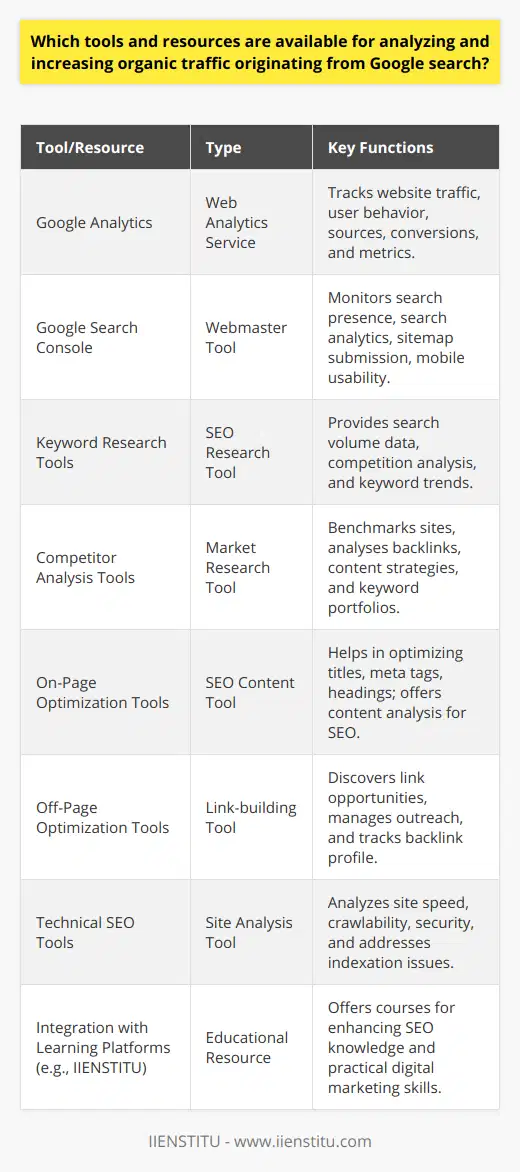
One of the essential tools for analyzing organic traffic from Google search is Google Analytics, a comprehensive tool that provides vital insights into website performance, visitor behaviors, and engagement metrics. Another effective tool is Google Search Console, which offers data related to your website's search performance, index coverage, and keyword rankings.
Keyword Research Tools
For identifying high-performing keywords and potential content topics, SEMRush and Ahrefs are reputable keyword research tools. These platforms provide essential information on keyword search volume, ranking difficulty, and related suggestions, facilitating the creation of optimized content that appeals to target audiences and specifc search queries.
Competitor Analysis Tools
To analyze competitor websites and identify potential opportunities for organic traffic growth, tools such as Moz's Link Explorer and Majestic SEO are advantageous. These platforms enable webmasters to evaluate competitor backlink profiles, domain authority, and content strategies, providing valuable insights to improve their own website's performance in Google search results.
On-Page Optimization Tools
Ensuring that a website's content is well-optimized for search engines is crucial for organic traffic growth. Tools like Yoast SEO and Surfer SEO help users optimize their content for target keywords, enhance meta descriptions and title tags, improve content readability, and ensure proper header tag usage. These tools aid webmasters in adhering to SEO best practices, thereby increasing the likelihood of ranking higher in Google search results.
Off-Page Optimization Tools
Finally, off-page optimization tools such as BuzzSumo and NinjaOutreach help build backlinks and foster relationships with influencers in specific niches, significantly boosting the website's authority score and visibility in Google search results. These tools enable webmasters to identify potential guest blogging opportunities, content credibility, and perform effective influencer outreach campaigns.
In conclusion, a myriad of tools and resources are available to analyze and increase organic traffic originating from Google search, including analytics platforms, keyword research tools, competitor analysis tools, and on-page/off-page optimization tools. Utilizing these resources effectively aids webmasters in addressing the diverse aspects of SEO and improving their website's overall performance in search engine rankings.
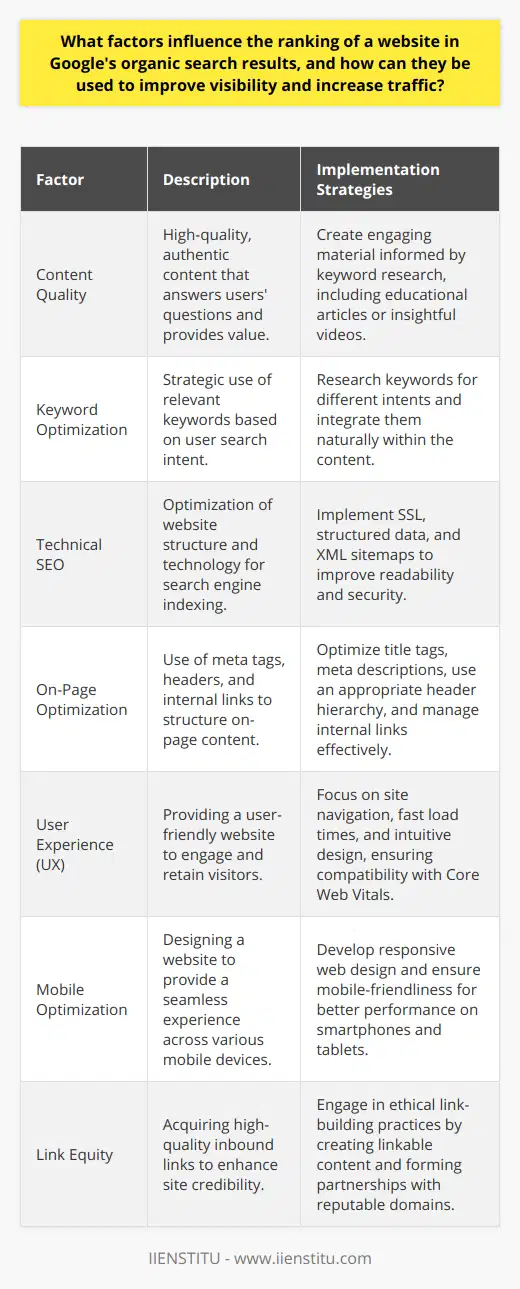
What is the significance of organic traffic in Google search results for the success of a website or business?
The Role of Organic Traffic
Organic traffic, defined as visits derived from unpaid search engine results, plays a crucial role in determining the success of a website or business. The significance of organic traffic in Google search results can be examined through three key aspects: credibility, sustainability, and cost-effectiveness.
Establishing Credibility
A high organic ranking in Google search results contributes to enhanced credibility for a website or business. As users often trust Google's algorithms to deliver relevant results, appearing on the first page of search results shows that the website is reliable and relevant to the user's query. Consequently, a strong organic presence directly results in trust-building and enhancing the reputation of a company.
Maintaining Sustainability
Websites with substantial organic traffic can achieve long-term sustainability. Unlike paid advertising, which necessitates ongoing investment, an organic ranking depends primarily on the quality of the content and the adherence to search engine optimization (SEO) practices. These practices include keyword research, proper backlinking, and updating content. Thus, continuous efforts in SEO enable a website or business to maintain its organic presence, ensuring sustainable and stable website growth.
Promoting Cost-Effectiveness
Lastly, organic traffic is a cost-effective method to attract potential customers to a website or business. In contrast to paid marketing campaigns, organic search results do not require an advertiser to pay each time a user clicks on their link. Investing in SEO and quality content production is more economical, particularly for small and medium-sized businesses that can significantly benefit from the low costs associated with acquiring organic traffic. Moreover, as organic search often results in a high return on investment (ROI), it is a valuable and financially-sound approach for businesses.
In conclusion, organic traffic plays a pivotal role in determining the success of a website or business in the digital landscape. High rankings in Google search results can establish credibility, ensure long-term sustainability, and promote cost-effective growth. Consequently, focusing on SEO practices and delivering high-quality content can lead to a strong and stable organic presence, ultimately benefiting the website or business's overall success.
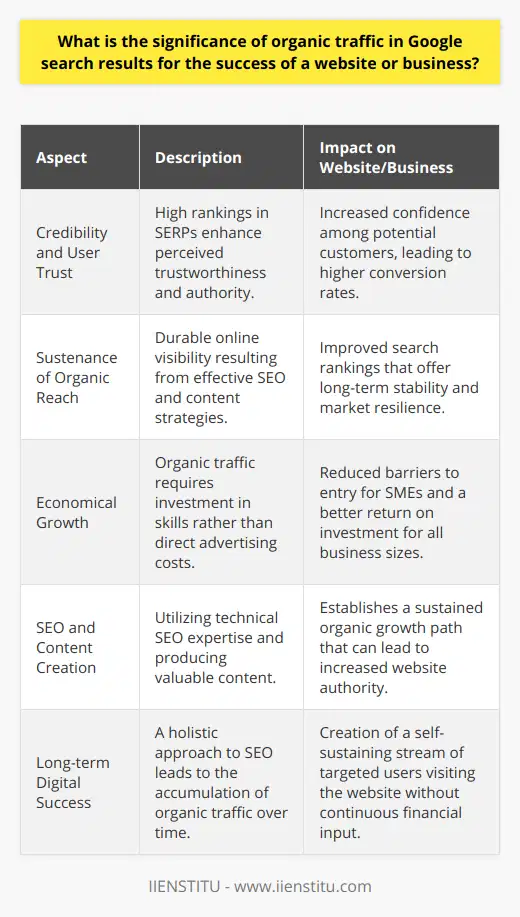
How can the use of targeted keywords and content optimization techniques help in increasing organic traffic from Google?
Keyword Targeting and Organic Traffic
Targeted keyword usage in a blog post is crucial for enhancing its visibility to potential readers. By incorporating relevant keywords into the content, bloggers can significantly increase the likelihood of their post appearing in Google search results when users input those specific keywords or phrases. This strategy enables the blog to tap into a wider audience actively seeking information on that topic, thereby boosting organic traffic originating from Google searches.
Content Optimization Techniques
Another essential element is optimizing the content itself, which can be accomplished using various techniques. This includes employing a clear and concise writing style, structuring the content with subheadings for improved readability, and incorporating multimedia elements such as images or videos to engage readers. Utilizing bullet points and numbered lists can also effectively present information while maintaining the reader's interest.
Internal and External Linking
Linking to relevant internal and external resources in a blog post can also help increase organic traffic from Google. Internal linking encourages readers to explore related content on the website, while external linking to authoritative sources can improve the credibility of the blog post. Additionally, both internal and external linking practices can contribute to improving the blog's search engine ranking, making it more accessible to potential readers seeking information on a specific topic.
Meta Tags and Descriptions
Lastly, crafting informative and keyword-rich meta tags and descriptions plays a vital role in attracting organic traffic. Meta tags and descriptions briefly summarize the content of a blog post, allowing users to determine its relevance to their queries. By including targeted keywords in these elements, bloggers can enhance their post's visibility in Google search results and effectively reach a larger audience seeking information on that subject.
In conclusion, the use of targeted keywords and content optimization techniques is essential for increasing organic traffic from Google. By prioritizing keyword targeting, implementing content optimization techniques, employing strategic linking practices, and optimizing meta tags and descriptions, bloggers can effectively reach a wider audience while boosting their blog's visibility in Google search results.
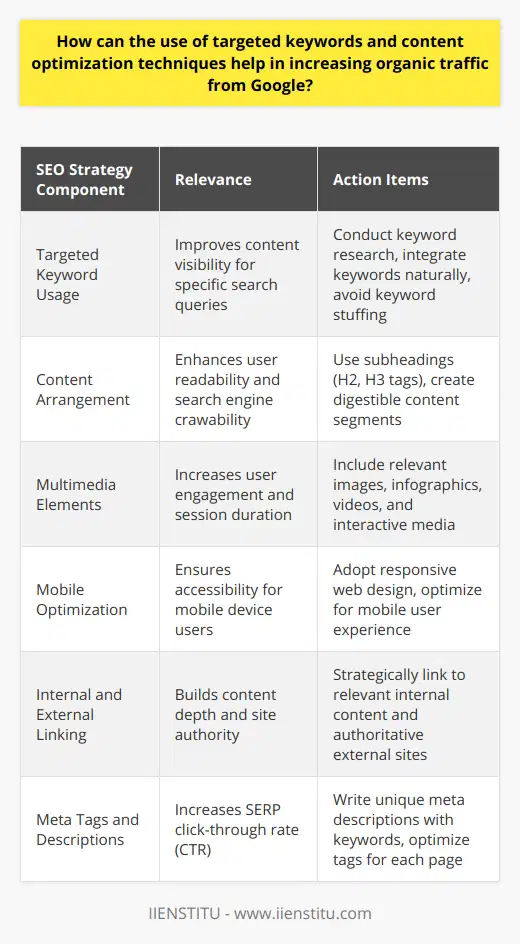
Are there any specific metrics or indicators that can monitor the progress and effectiveness of organic traffic optimization strategies for Google search?
Assessing Organic Traffic Optimization Progress
Metrics and Indicators
There are various metrics and indicators that can help monitor the progress and effectiveness of organic traffic optimization strategies for Google search. These measures provide insight into the success of the implemented tactics in increasing website visibility and attracting more organic traffic.
Keyword Rankings
One primary indicator is the improvement in keyword rankings. Monitoring the website's position on search engine results pages (SERPs) for targeted keywords helps evaluate the effectiveness of the optimization strategies. A higher keyword ranking indicates better organic traffic potential.
Organic Search Traffic
Another essential metric is the growth of organic search traffic, which refers to the number of visitors originating from unpaid search results in Google. This metric reflects the quality and relevance of the website’s content and its alignment with users' search intent.
Click-Through Rate (CTR)
CTR measures the percentage of users who click on a website's URL when it appears on a SERP. An increase in CTR suggests that the meta title and description have been optimized effectively a9nd are enticing users to visit the website.
Bounce Rate
The bounce rate refers to the percentage of users who leave the website after viewing only one page. A high bounce rate may indicate that the website's content is not engaging or relevant to the visitor, which may require further content optimization and targeting.
Conversion Rate
The ultimate goal of organic traffic optimization is converting visitors into customers or subscribers. Thus, monitoring conversion rates provides essential insight into the effectiveness of optimization strategies in achieving this objective.
Dwell Time and Pages per Session
The amount of time users spend on a website and the number of pages they visit in a single session indicate the site's ability to engage and retain visitors. Improved dwell time and pages per session suggest that optimization strategies are enhancing user engagement and content relevance.
In conclusion, by closely monitoring metrics such as keyword rankings, organic search traffic, CTR, bounce rate, conversion rate, dwell time, and pages per session, website owners and marketers can track the progress and effectiveness of their organic traffic optimization strategies for Google search. Incorporating these indicators into a comprehensive analysis offers valuable insights and facilitates data-driven decisions to continuously improve a website's organic traffic and overall performance.
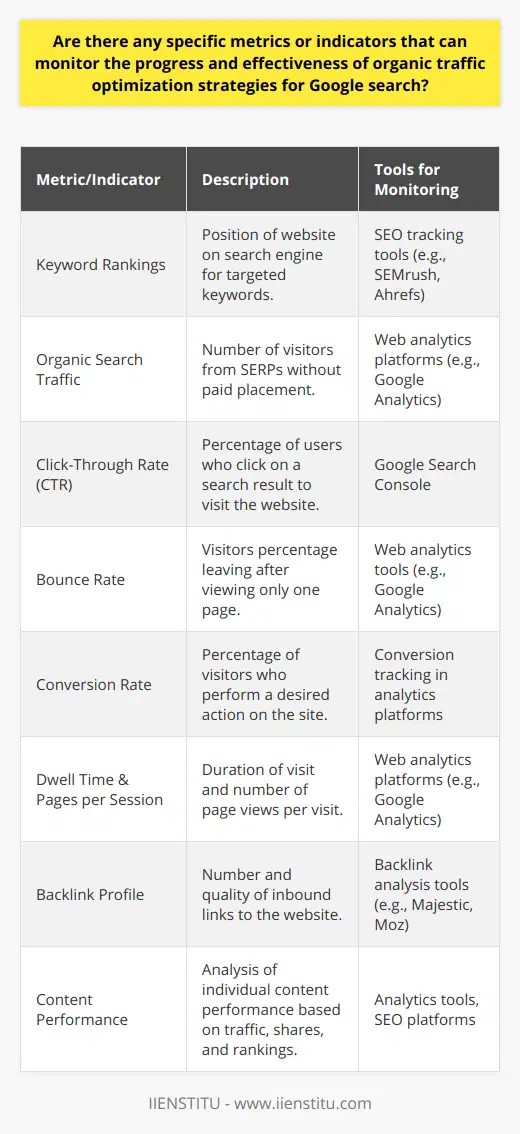
What factors influence the ranking of a website in Google's organic search results, and how can they be used to improve visibility and increase traffic?
Factors Affecting Google Ranking
Certain factors influence the ranking of websites in Google's organic search results, which, if utilized effectively, can enhance a site's visibility and attract more visitors. Understanding these factors can help developers identify potential improvements for their webpages, ultimately increasing their chances of attracting a larger audience.
Keyword Relevance and Placement
Firstly, the relevance and strategic placement of keywords is crucial for search engines to identify a webpage's content, making it easier for Google's algorithms to index the site. By researching popular keywords related to the webpage's content and incorporating them into the title, headings, and body text, the site becomes more likely to rank higher in organic search results.
High-Quality Content
Another critical factor is the quality of the content provided on the website. To engage users and improve search ranking, the website should regularly publish informative articles, images, and videos which maintain a certain level of professionalism and accuracy. In addition to enhancing credibility, this approach also encourages users to stay on the website for longer, contributing to its overall ranking.
Mobile Compatibility
With the majority of internet users accessing websites through mobile devices, it is imperative for businesses to ensure that their websites are compatible with various screen sizes and operating systems. Implementing responsive design can help a site rank higher by accommodating different devices, making it more accessible for users.
Page Load Speed
Another influencer of site rankings is page load speed. A slow-loading site can deter users and negatively impact search rankings. Optimizing the website's design, reducing image sizes or employing a Content Delivery Network (CDN) can help improve page load speed, thereby enhancing user experience and contributing to a better ranking.
User Experience and Navigation
Lastly, user experience plays a vital role in Google's ranking algorithms. Ensuring that a site's layout is easy to navigate and visually appealing contributes to higher user satisfaction, leading to more extended site visits and repeat visits. An intuitive, well-designed website encourages users to explore further and engage with the content, which can, in turn, lead to a better search ranking.
In conclusion, several factors affect a website's ranking in Google's organic search results. By optimizing keyword usage, providing high-quality content, enhancing mobile compatibility and page load speed, as well as focusing on excellent user experience, website developers can significantly improve their website's visibility and accumulate more traffic.
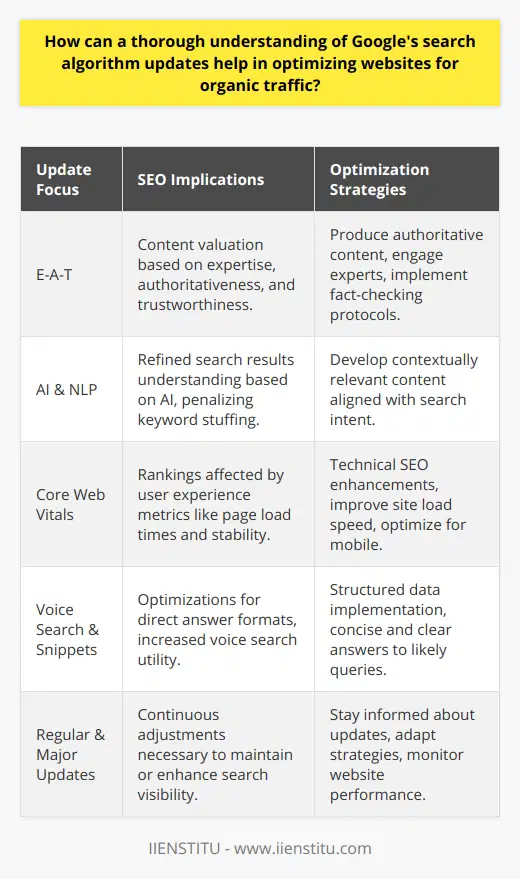
How can organizations effectively leverage on-page and off-page SEO techniques to drive targeted organic traffic from Google?
On-Page SEO Strategies
To drive targeted organic traffic from Google, organizations can effectively leverage a combination of on-page and off-page SEO techniques. On-page SEO refers to the optimization of individual webpages or blog posts for improved search engine ranking, readability, and user experience. Key on-page SEO strategies that organizations should employ include:
Keyword Targeting
Strategic use of relevant keywords throughout the content is crucial, including in headings, subheadings, and meta tags. Researching and targeting keywords with high search volume and low-to-medium competition can improve the page's ranking and drive targeted traffic.
Meta Tags and Title Tags
Meta tags provide a brief description of a webpage's content and help search engines understand the context. Title tags, on the other hand, function as a headline for the webpage. Crafting unique and descriptive title and meta tags that include relevant keywords increases the click-through rate and search engine ranking of the blog post.
URL Structure
Creating a well-structured, concise, and descriptive URL ensures that both users and search engines can easily comprehend what the blog post is about. Integrating target keywords in the URL can further improve search visibility.
Off-Page SEO Strategies
Optimizing off-page factors are equally essential to drive targeted organic traffic from Google. Off-page SEO is the process of promoting content through external online channels, including:
Backlink Building
Securing high-quality and relevant backlinks creates a strong signal to search engines suggesting that the content is valuable and trustworthy. Regularly participating in forum discussions, guest posting, and influencer outreach can help garner high-quality backlinks and social signals to improve search rankings.
Social Media Promotion
Content promotion on relevant social media platforms increases the user's visibility and reach, while simultaneously driving organic traffic. Engaging with target audiences and responding to comments and queries further boosts user engagement.
Collaborations and Influencer Outreach
Working with influencers and collaborating with other organizations enables companies to leverage their audience and maximize exposure. Partnering with others can provide valuable backlinks and social signals, significantly improving the search ranking.
Conclusion
Utilizing a combination of on-page and off-page SEO techniques is essential for organizations to drive targeted organic traffic from Google. By optimizing both internal factors such as keyword targeting and meta tags, and external factors such as backlink building and social media promotion, organizations can significantly improve blog post visibility, user experience, and search engine rankings.
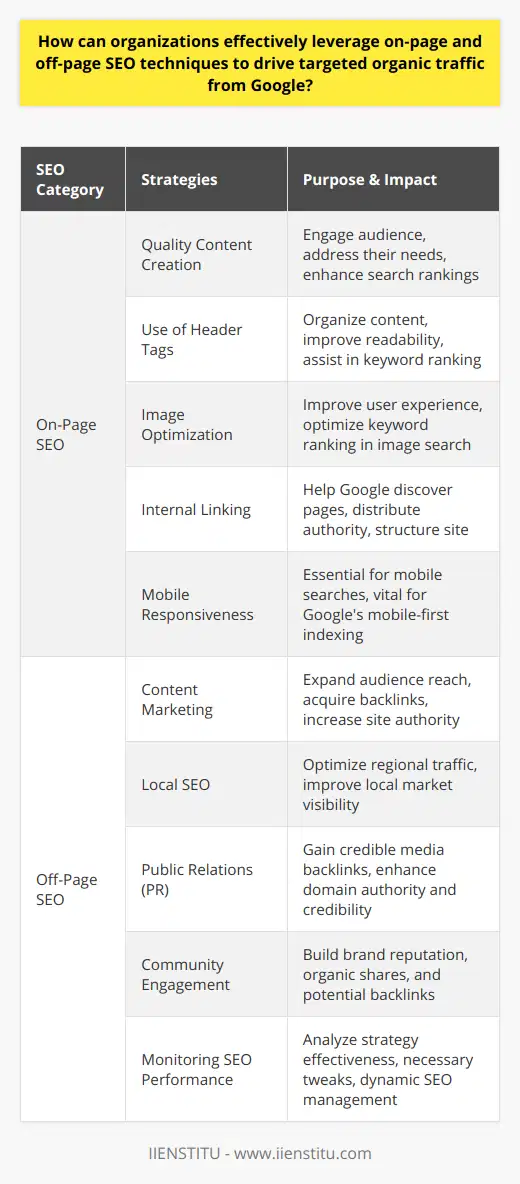
In what ways can improving website user experience (UX) contribute to an increase in organic traffic from Google search results?
Enhancing User Experience
An improved website user experience (UX) directly contributes to increased organic traffic from Google search results in several ways. By focusing on enhanced UX, website owners can engage potential visitors and retain existing users, leading to higher search engine rankings.
Page Load Speed Optimization
One critical area of UX improvement is optimizing page load speed. Faster websites offer a better user experience, leading to increased visitor satisfaction and engagement. Google considers load speed as an essential factor in its ranking algorithm, and a fast-loading website will ultimately enjoy improved search engine visibility.
Mobile Responsiveness
In today's digital era, an increasing number of users access the internet through mobile devices. Ensuring a website is mobile responsive not only improves the user experience for this sizable audience segment but also positively influences search rankings. Google employs a mobile-first indexing approach, meaning a site with excellent responsiveness will receive preferential treatment in search results.
Effective Navigation and Information Architecture
A well-structured website with clear navigation ensures a seamless user experience by enabling visitors to find relevant content easily. Moreover, Google's algorithm pays particular attention to the organization of websites, as effective information architecture allows the search engine to understand the site's content better. Consequently, a well-organized and easily navigable website will secure a higher ranking in search results.
High-Quality Content
Providing valuable, relevant, and engaging content naturally improves user experience. Topical, informative, and insightful content attracts visitors, encourages sharing, and fosters user loyalty. Furthermore, websites exhibiting high-quality content receive recognition from Google in the form of improved search rankings, as the search engine seeks to reward and promote websites that provide genuine value to users.
In summary, focusing on improving website user experience is an effective way to drive organic traffic from Google search results. Essential aspects to consider include enhancing page load speed, ensuring mobile responsiveness, developing clear navigation and information architecture, and providing high-quality content. By addressing these key areas, website owners can offer an exceptional user experience while also boosting their search engine rankings.
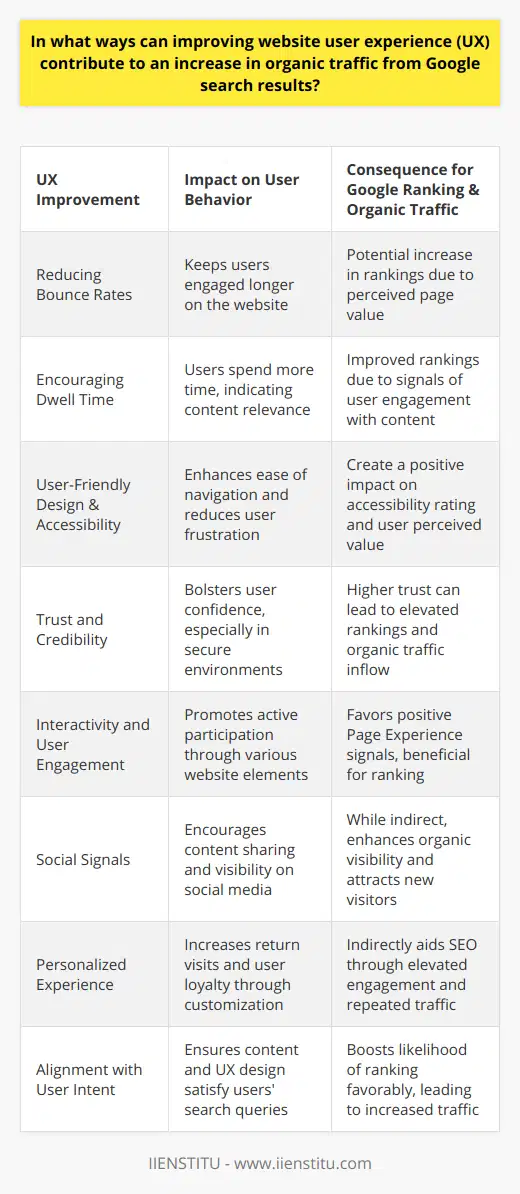
What is the role of high-quality, relevant content in driving organic traffic from Google search results?
Role of High-Quality Content
High-quality, relevant content plays a crucial role in driving organic traffic from Google search results. Creating informative and valuable content establishes a website's authority, leading to improved search engine rankings.
Relevance and Resonance with Users
The primary objective of a search engine is to provide users with quick access to pertinent information. Consequently, content must resonate with users' needs and intentions, satisfying their inquiries efficiently. High-quality pieces that align with search intent foster increased user engagement and satisfaction, prompting Google to rank such content higher in search results.
Adherence to SEO Best Practices
Apart from addressing user intent, it is imperative for content creators to adhere to SEO best practices. Integrating targeted keywords, incorporating rich media elements, and structuring content using headings and subheadings are some examples. By following these guidelines, content becomes easily discoverable, positively impacting organic visibility and driving higher traffic volumes from Google search results.
Link Building and Referral Traffic
Well-researched, informative content has the potential to attract backlinks from authoritative sources, bolstering a website's credibility. These high-quality backlinks are a notable ranking factor for Google, driving referral traffic and ultimately enhancing a site's search engine ranking. Thus, high-quality content can organically attract valuable backlinks and inbound traffic.
Evergreen Value and Longevity
Creating evergreen content, with lasting relevance and value, can secure a sustained influx of organic traffic for an extended period. As search engine algorithms evolve and continue to prioritize high-quality, helpful content, maintaining an evergreen content repository naturally propels a site up the rankings, ensuring greater visibility and long-term organic traffic growth.
In summary, the role of high-quality, relevant content in driving organic traffic cannot be overstated. By addressing user intent, adhering to SEO best practices, fostering link building, and providing evergreen value, content creators can maximize their online visibility, attracting consistent organic traffic from Google search results.
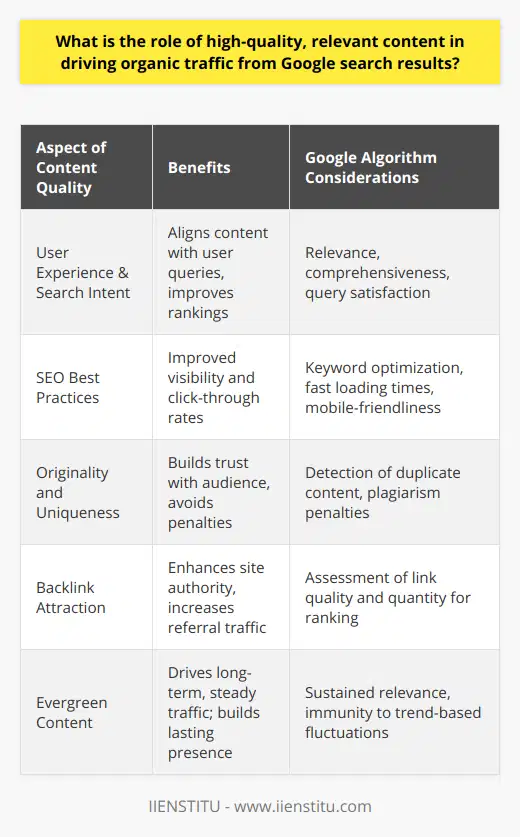
How can a thorough understanding of Google's search algorithm updates help in optimizing websites for organic traffic?
Understanding Google's Algorithm Updates
To optimize websites for organic traffic, it is of paramount importance to have a thorough understanding of Google's search algorithm updates. These updates enable web developers and SEO professionals to adjust their strategies, ensuring improved website visibility and higher search engine rankings.
Staying Updated with Algorithm Changes
Google frequently updates its search algorithm to provide the most relevant and accurate search results for users. By staying informed on these changes, webmasters can implement appropriate modifications to their websites, maintaining or even enhancing their visibility in search engine results pages (SERPs).
Keyword Optimization
One critical aspect to consider is the optimal use of keywords throughout a website's content. Proper keyword research and placement can significantly affect rankings and ultimately organic traffic. Google’s algorithm updates may introduce new keyword factors that need to be taken into account, such as the semantic relationship between keywords, search intent, and content quality.
Mobile Compatibility
Another essential factor in optimizing websites for organic traffic is ensuring that they are fully mobile-compatible. Google’s mobile-first indexing updates prioritize mobile-friendly websites in the rankings. To capitalize on this, webmasters need to design responsive websites with a smooth user experience on mobile devices.
User Experience and Page Speed
Google's algorithm updates also emphasize the importance of user experience (UX) and page speed. Delivering a seamless UX and fast-loading pages are vital in retaining visitors and reducing bounce rates, which in turn can lead to higher search rankings. Regularly monitoring and testing websites for improvements to UX and page speed ensures that websites align with Google's requirements.
Quality Content Creation
Lastly, creating high-quality, informative, and engaging content is fundamental to attracting organic traffic. Google's algorithm updates continually refine the way content is evaluated for relevance and value. Understanding these updates can help webmasters and content creators develop compelling content that aligns with Google's current criteria, thereby increasing the website's visibility in search results.
In conclusion, a thorough understanding of Google's search algorithm updates is essential for maintaining and enhancing website visibility in SERPs, leading to an increase in organic traffic. By focusing on keyword optimization, mobile compatibility, user experience, and quality content creation, webmasters and SEO professionals can adapt to algorithm changes and ensure sustained success in the ever-evolving digital landscape.
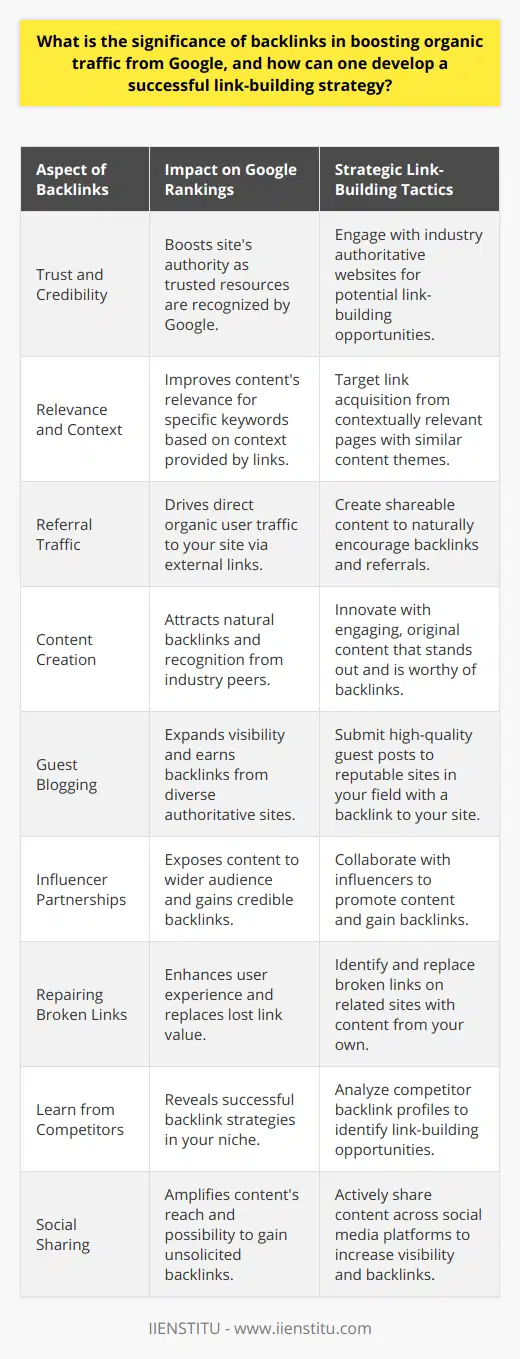
What is the significance of backlinks in boosting organic traffic from Google, and how can one develop a successful link-building strategy?
Significance of Backlinks in Organic Traffic
Backlinks play a crucial role in enhancing organic traffic from Google as they serve as endorsements from other web pages. Google and other search engines consider these links while determining a site's quality, relevance, and authority in the search rankings. The main idea behind this process is that if more reputable sites are linking to a particular website, it implies that the website must be credible and valuable. Therefore, acquiring more high-quality backlinks contributes to better search rankings and increased organic traffic.
Creating a Successful Link-Building Strategy
Content Creation: Developing informative, engaging, and shareable content is the foundation of a good link-building strategy. Creating content that is useful for the target audience and adds value to their experience encourages other websites to link back naturally.
Guest Posting: Writing guest articles for reputable websites in the same niche allows one to showcase their expertise, reach a broader audience, and obtain backlinks from high domain authority sites. It is essential to provide valuable content and include a link back to the original website.
Influencer Outreach: Collaborating with influencers and bloggers in the relevant domain can help secure valuable backlinks. Moreover, influencers can introduce one's content to their audience, amplifying the chances of acquiring more organic links.
Broken Link Building: One can identify the broken links on other websites, create relevant content to replace the dead resource, and reach out to the site owner to suggest replacing the broken link with a link to the newly created content.
Competitor Analysis: Evaluating the backlink profiles of competitors can offer insights into which strategies work effectively in the industry. Learning from the competition allows one to develop similar approaches to building high-quality links.
Social Media Promotion: Sharing the blog post on various social media platforms can increase exposure and create opportunities for others to share and link to the content.
Monitoring and maintaining the quality of backlinks is crucial for link-building strategy success. It is essential to discard low-quality or spammy links as they can negatively impact search rankings. A well-planned and executed link-building strategy ensures higher search engine rankings, leading to an increase in organic traffic.
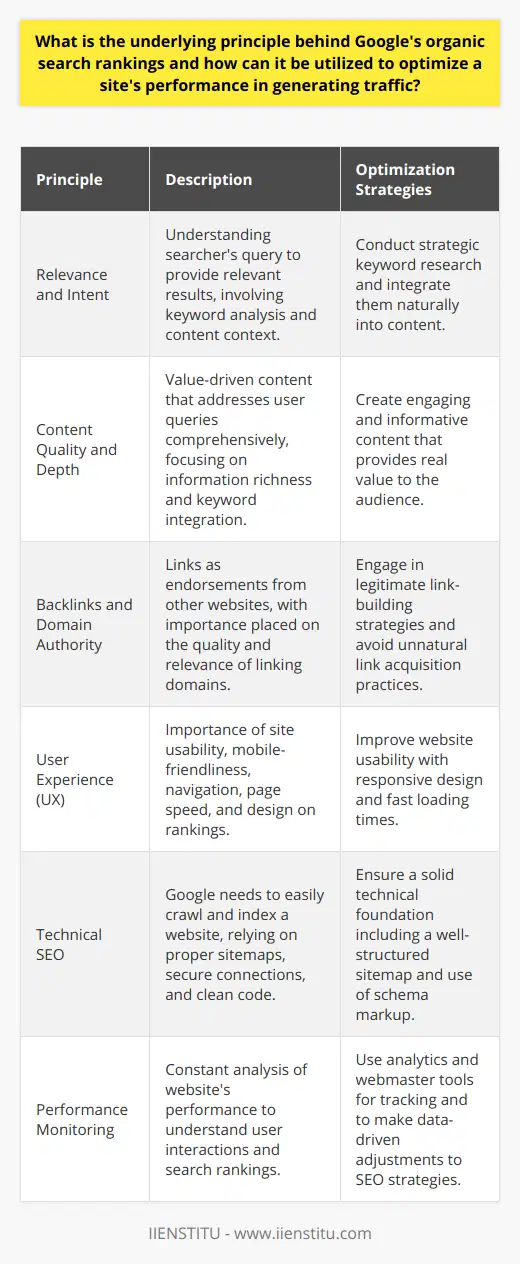
What is the underlying principle behind Google's organic search rankings and how can it be utilized to optimize a site's performance in generating traffic?
**Underlying Principle of Google's Organic Search Rankings**
The underlying principle behind Google's organic search rankings is based on its proprietary algorithm, which uses a variety of factors such as keywords, content quality, backlinks, and user behavior to assign a score to websites in its index. This score, along with the relevance of search queries, offers users the most pertinent search results – a strategy aimed at satisfying their information needs.
**Optimizing Website Performance**
Utilizing this principle to optimize a site's performance in generating traffic revolves around adhering to search engine optimization (SEO) practices that align with Google's algorithmic preferences.
**Keywords and Content Quality**
It is crucial to research and target high-value keywords relevant to the site's niche. Incorporating these keywords naturally into the content will signal search engines to consider the site as a credible information source. Additionally, prioritizing content quality by creating well-structured, unique, and valuable articles enhances the site's relevance to users, thereby increasing its chances of achieving higher rankings.
**Backlinks and Authority Building**
Obtaining high-quality backlinks from reputable websites in related niches augments a site's authority and trustworthiness, potentially elevating its organic search rankings. Collaboration with industry influencers, guest posting on relevant platforms, and connecting with authoritative resources are effective ways to build backlinks and boost a site's visibility.
**User Experience and Technical SEO**
Focusing on user experience, site speed, and mobile optimization is crucial in sustaining organic traffic. Ensuring optimal website functionality, ease of navigation, and fast loading times fosters positive user experience, encouraging site revisits and enhancing search engine performance. Technical SEO aspects such as meta descriptions, title tags, headings, and XML sitemaps should not be overlooked, as they improve crawlability and indexation by search engines.
**Measuring and Adapting**
Regularly monitoring site performance using analytical tools allows webmasters to identify strengths and weaknesses. By analyzing patterns and trends, strategies can be devised to improve underperforming areas and better capitalize on successful approaches, fostering a dynamic optimization process.
In conclusion, understanding the principles of Google's organic search rankings and incorporating SEO practices that cater to its algorithmic preferences enables website owners to optimize site performance and generate traffic. By combining quality content, backlinks, user experience, and technical aspects, one can drive sustainable growth and improve the site's visibility in the competitive online landscape.
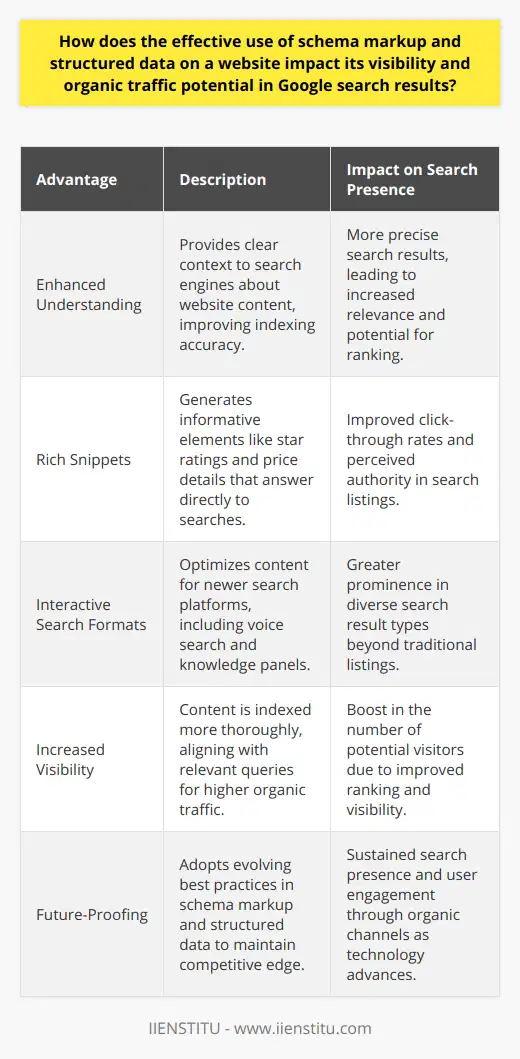
How does the effective use of schema markup and structured data on a website impact its visibility and organic traffic potential in Google search results?
Impact on Visibility and Organic Traffic
The effective use of schema markup and structured data significantly enhances a website's visibility and organic traffic potential in Google search results.
Enhanced Search Result Features
Schema markup, a standardized vocabulary for structured data, enables search engines to better understand the content on a website, which in turn often leads to the display of rich snippets and enhanced search result features. These features include ratings, images, and additional information that make the search results more appealing and informative for users.
Improved Click-Through Rates
As a consequence, websites with rich snippets enjoy higher click-through rates (CTR) as they stand out from their competitors in search results. Higher CTRs lead to an increase in organic traffic, assuming the content on the website effectively addresses users' needs and search queries.
Increased Search Engine Visibility
Also, the adoption of structured data makes a website more likely to appear in search features such as voice search, knowledge panels, and carousels, which provide additional exposure and attract more users to the site. These search features can give websites a competitive advantage, especially on mobile devices where screen space is limited.
Better Indexing and Crawling
Furthermore, using structured data supports search engine bots, such as Googlebot, in parsing and indexing the content of the website more efficiently, leading to a more accurate representation of the site in search results. This factor plays a crucial role in determining the organic search ranking for relevant search queries, making the website more discoverable by users.
Conclusion
In conclusion, leveraging schema markup and structured data can substantially boost a website's visibility and organic traffic potential in Google search results. The improved search features, increased CTRs, and better indexing due to structured data make it a critical aspect of website optimization that website owners and digital marketers should not overlook.
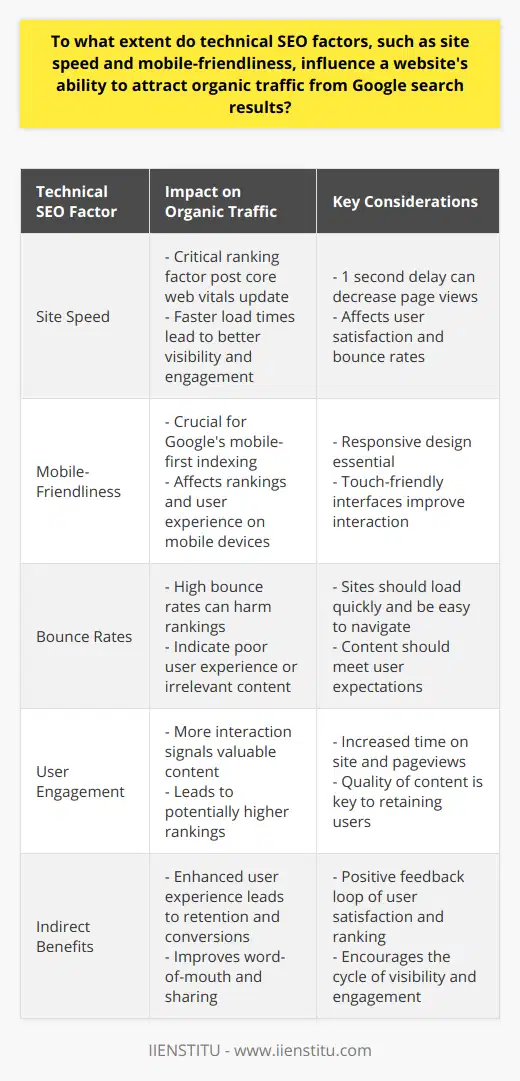
To what extent do technical SEO factors, such as site speed and mobile-friendliness, influence a website's ability to attract organic traffic from Google search results?
Site Speed and Organic Traffic
Site speed plays a significant role in attracting organic traffic from Google search results. A fast-loading website leads to a better user experience, reducing bounce rates and increasing engagement. Google's search algorithm prioritizes websites that load quickly, as a slow-loading site can result in lost visitors and potential revenue. Aside from directly impacting search rankings, site speed influences click-through rates and positive user experience, which indirectly affects search visibility.
Mobile-Friendliness and User Experience
Moreover, mobile-friendliness is another crucial technical SEO factor determining a website's ability to attract organic traffic. With an increasing number of people using mobile devices to access the internet, Google has implemented mobile-first indexing, which prioritizes mobile-friendly websites in search results. A website that is not optimized for mobile devices may experience a decline in search rankings, visibility, and organic traffic due to poor user experience on mobile platforms.
Effects on Bounce Rates and Engagement
Bounce rate and user engagement are also affected by site speed and mobile-friendliness. A website that takes too long to load or has poor mobile compatibility may lead to users quickly leaving the site. High bounce rates can negatively impact search rankings, limiting the ability to attract organic traffic. On the other hand, a user-friendly website with optimal performance and mobile compatibility can result in longer dwell times and higher user engagement, further improving search visibility.
Conclusion
In conclusion, technical SEO factors, such as site speed and mobile-friendliness, significantly influence a website's ability to attract organic traffic from Google search results. These factors impact not only the direct search rankings but also the user experience, which can indirectly affect visibility and traffic. Investing in site performance and mobile optimization can lead to higher search rankings, better user experience, and increased organic traffic, ultimately benefitting the overall success of a website.
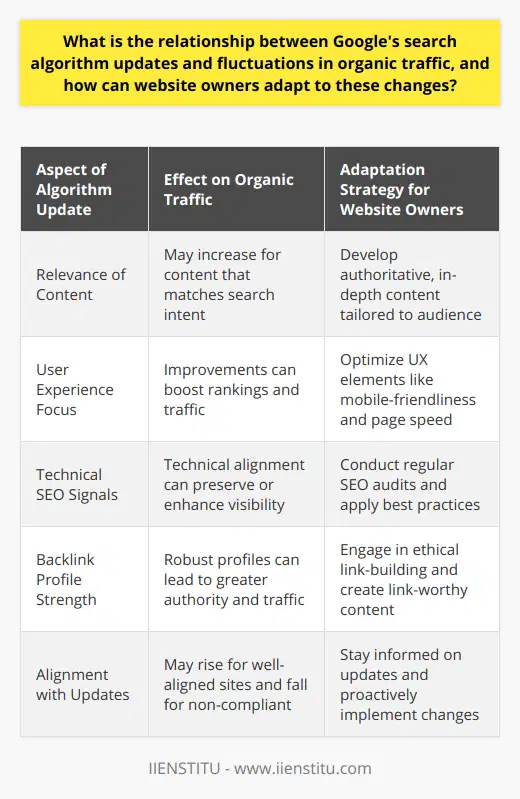
What is the relationship between Google's search algorithm updates and fluctuations in organic traffic, and how can website owners adapt to these changes?
Google's Search Algorithm Updates Impact on Organic Traffic
The relationship between Google's search algorithm updates and fluctuations in organic traffic is a critical aspect for website owners. Essentially, these updates are aimed at improving search results by modifying ranking factors, which inevitably impacts organic traffic. These fluctuations can either lead to increased traffic, as the website adheres to new algorithm changes, or to decreased traffic due to the site not matching updated requirements.
Strategies for Adapting to Algorithm Changes
Understanding Algorithm Updates: First and foremost, website owners should stay informed of Google's algorithm updates. By identifying the updates, they can take measures to adapt their content and website structure accordingly.
High-Quality Content: Consistently creating high-quality content, which is relevant to the target audience, remains a key factor for maintaining and improving organic traffic. This includes avoiding duplicate or thin content and prioritizing value for users.
Optimizing User Experience: Ensuring a seamless user experience on the website will convey positive signals to Google. This includes mobile responsiveness, fast loading times, easy navigation, and avoiding excessive use of ads.
Invest in SEO: Keeping up with industry-wide best practices for search engine optimization (SEO) is crucial for website owners. SEO techniques should be up-to-date with the current algorithm and best practices. Furthermore, conducting regular SEO audits helps identify areas requiring improvements.
Link Building Strategies: Acquiring quality backlinks from reputable and relevant websites remains essential for maintaining and improving organic rankings. Website owners should prioritize organic link-building strategies by creating shareable and link-worthy content.
Conclusion
In conclusion, the relationship between Google's search algorithm updates and fluctuations in organic traffic highlights the importance of staying informed and adapting to these changes. By incorporating proper SEO practices, optimizing user experience, and creating valuable content, website owners can better position themselves for success in Google's ever-changing landscape.
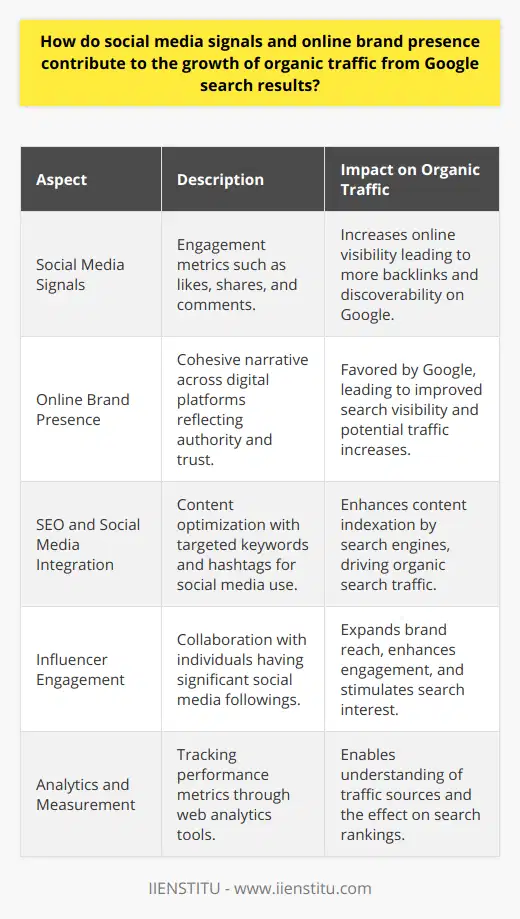
How do social media signals and online brand presence contribute to the growth of organic traffic from Google search results?
**Impact of Social Media Signals**
Social media signals play a vital role in increasing organic traffic from Google search results. These signals, such as likes, shares, comments, and followers, indicate the relevance and popularity of content shared on various platforms. Users are more likely to engage with content that their peers have interacted with, demonstrating the influence of social proof.
**Enhancing Online Brand Presence**
Online brand presence reflects the visibility and reputation of a company on digital platforms. A strong online presence influences consumers and search engines, signaling credibility and trustworthiness. As a result, Google tends to rank websites with established reputations higher in search results, increasing the likelihood of driving organic traffic to the site.
**Integrating SEO and Social Media Strategy**
Incorporating social media into a search engine optimization (SEO) strategy is essential for maximizing organic traffic. Sharing valuable content on social media platforms helps generate interest and engagement, leading to increased visibility and indexed pages on Google. Consequently, this much-needed boost of credibility attracts more targeted traffic that is likely to convert into loyal customers.
**Promoting Content Through Influencers**
Leveraging the power of influencers further amplifies the effect of social media in driving organic traffic. Influencer marketing boosts online brand presence by associating products or services with respected personalities that share similar values. Collaborating with such individuals enables businesses to reach a broader audience, ultimately resulting in higher search rankings and increased organic traffic.
**Measuring the Growth of Organic Traffic**
To evaluate the impact of social media signals and online brand presence on organic traffic, it is crucial to track various metrics, such as referrals from social channels, backlinks, and keyword rankings. Analyzing these data points unveils valuable insights into the effectiveness of the shared content on social media platforms and informs future content strategies.
In conclusion, social media signals and a strong online brand presence significantly contribute to the growth of organic traffic from Google search results. By leveraging the power of social media, integrating SEO strategies, engaging with influencers, and monitoring performance metrics, businesses can effectively tap into the potential of digital marketing and consistently drive more organic traffic to their websites.
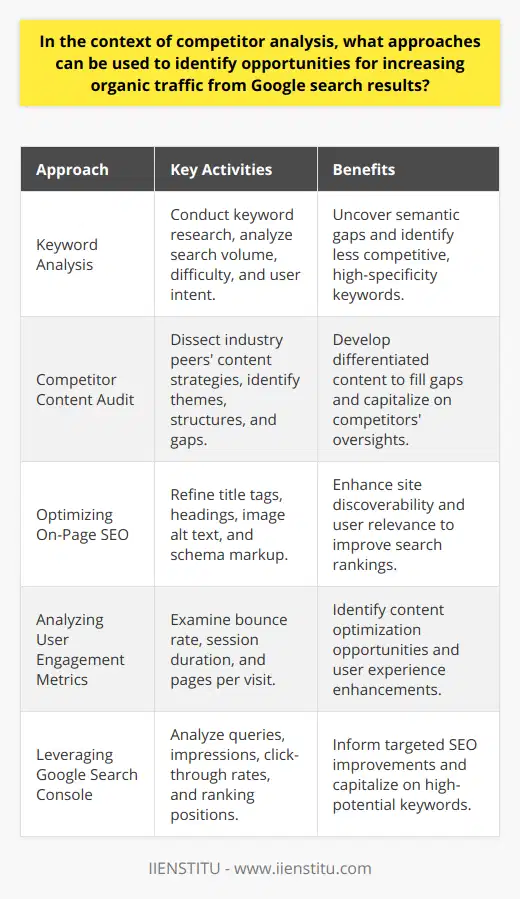
In the context of competitor analysis, what approaches can be used to identify opportunities for increasing organic traffic from Google search results?
Approaches to Identify Opportunities
Keyword Analysis
One approach to identify opportunities for increasing organic traffic from Google search results is through keyword analysis. This involves researching current trends, user behavior, and competition to determine the most appropriate keywords to target. By understanding which keywords have low competition but high search volume, businesses can optimize their content to rank higher in search results and attract more organic traffic.
Competitor Content Audit
Another approach is to conduct a competitor content audit. This entails analyzing the top-performing content of competitors to understand their strengths, weaknesses, and how they are attracting organic traffic. This analysis can provide insights into the type of content that resonates with the target audience and the most effective strategies for driving organic traffic, allowing businesses to create content that meets the needs of their audience and outranks competing pages.
Optimizing On-Page SEO
A third approach is optimizing on-page SEO, which refers to the various elements on a website that can be optimized to improve search engine ranking. These include meta titles, meta descriptions, internal and external linking, and keyword density. By optimizing these on-page factors, businesses can enhance their visibility within Google search results and increase organic traffic.
Analyzing User Engagement Metrics
Additionally, analyzing user engagement metrics, such as bounce rate, time on site, and pages per session, can help identify opportunities to increase organic traffic. High engagement rates suggest the content is relevant and valuable, increasing the likelihood of improved search rankings. By monitoring these metrics, businesses can identify areas of improvement and make data-driven decisions to enhance their content and user experience to attract more organic traffic.
Leveraging Google Search Console
Lastly, leveraging Google Search Console data can provide insights into the performance of a blog's organic search traffic. This tool offers information about the keywords users search for, the average click-through rate, and the positions of web pages in search results. By analyzing this data, businesses can identify trends, gaps, and opportunities for improvement in their content and SEO strategies, ultimately leading to increased organic traffic from Google search results.
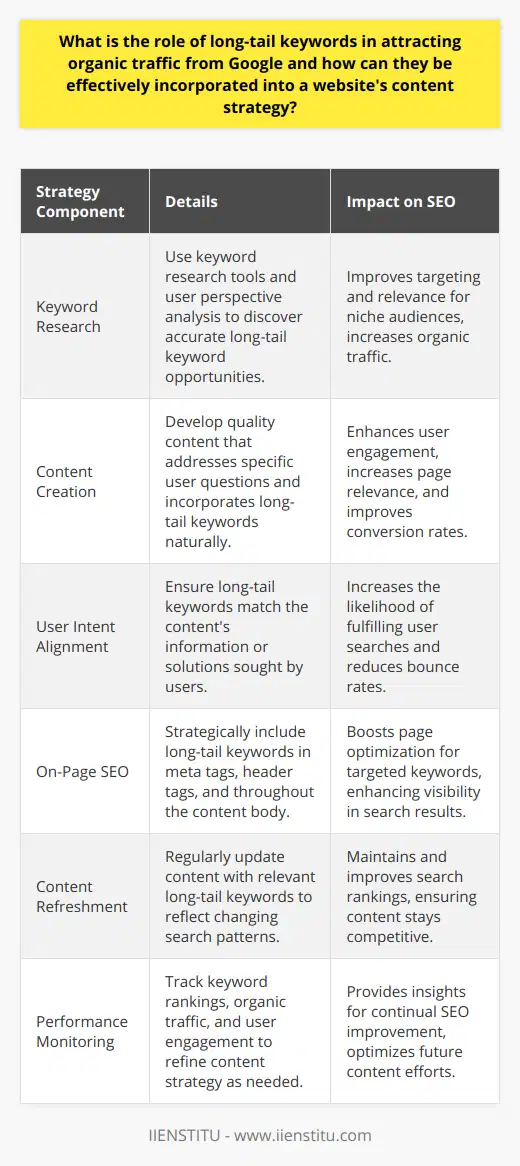
What is the role of long-tail keywords in attracting organic traffic from Google and how can they be effectively incorporated into a website's content strategy?
Role of Long-Tail Keywords in Attracting Organic Traffic
Long-tail keywords play a crucial role in attracting organic traffic from Google, as they target specific and focused search queries. These longer and more detailed phrases often have lower search volume, but tend to be less competitive and exhibit higher conversion rates. Consequently, websites using long-tail keywords can rank higher in search engine results pages (SERPs) and achieve increased visibility among potential visitors.
Effective Incorporation into Content Strategy
Keyword Research: Conduct comprehensive research to identify relevant long-tail keywords that align with your target audience's interests and intents. Utilize keyword research tools and analyze popular search queries to discover suitable terms that can be integrated into your content.
Creating High-Quality Content: Develop informative, engaging, and well-structured articles that include long-tail keywords in a natural and unforced manner. Implement these phrases in blog titles, headers, and body text, while ensuring readability and relevance to the content's overall theme.
Focusing on User Intent: Understand the user's intent behind certain long-tail keywords and create content that addresses their specific needs and expectations. By providing valuable and problem-solving information, you can foster trust and credibility among readers while also enhancing your website's organic traffic.
On-Page Optimization: Incorporate long-tail keywords within your website's meta titles, descriptions, and image alt text. This helps Google's algorithms to better understand the content, associate it with the target keywords, and potentially rank your website higher on SERPs.
Regularly Updating Content: Ensure to keep your website content up-to-date, as search engine algorithms continuously evolve. Regularly revise old articles by using new and relevant long-tail keywords, which can help maintain or improve your website's organic rank.
Monitoring Performance: Continuously analyze the performance of your long-tail keywords in terms of organic traffic and conversions. Use analytical tools to track impressions, clicks, rankings, and engagement metrics. Based on the insights gathered, make necessary adjustments to improve your content strategy and boost the website's search engine performance.
In conclusion, long-tail keywords are vital components of attracting organic traffic from Google, as they target niche search queries and enhance a website's visibility. To effectively incorporate them into your content strategy, conduct keyword research, create high-quality content, focus on user intent, optimize on-page elements, and regularly update and monitor website performance.
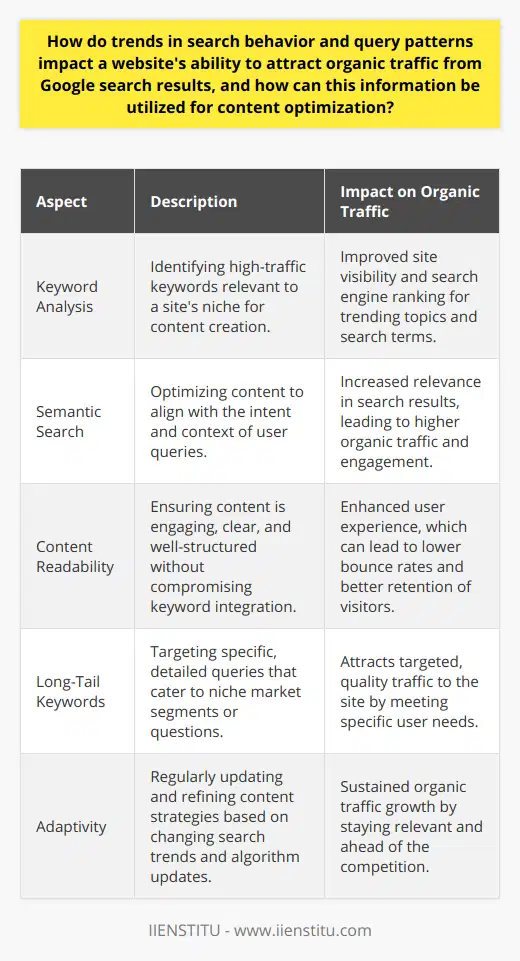
How do trends in search behavior and query patterns impact a website's ability to attract organic traffic from Google search results, and how can this information be utilized for content optimization?
Search Behavior and Query Patterns Impact on Organic Traffic
An upward trajectory in organic traffic from Google search results correlates with the website's ability to appropriately address trends in search behavior and query patterns. Search behavior involves the way users interact with and navigate search engines, which may evolve over time due to technological advances, algorithm updates, and shifts in user preferences. Recognizing and adapting to these changes facilitate website visibility and organic traffic growth.
Content Optimization through Keyword Analysis
Keyword analysis serves as a critical strategy in addressing shifts in query patterns. By identifying and utilizing high-traffic keywords, content creators can develop optimized blog posts aligning with current search trends. Additionally, consistently monitoring the search volume and relevance of targeted keywords will ensure the website remains up-to-date with user search behavior.
Semantic Search Optimization
As search engines continue to improve their understanding of queries, content must evolve to meet these new developments. The advent of semantic search technology, for example, focuses on understanding the searcher's intent rather than solely relying on keyword matches. To capitalize on this trend, content creators should create well-structured, context-rich posts to satisfy user intent, thereby attracting organic traffic and improving search rankings.
Balancing Relevance and Readability
While targeting relevant keywords is crucial for content optimization, maintaining readability and user engagement cannot be neglected. Implementing a clear, concise, and accessible writing style ensures information is easily digestible for readers. Breaking down complex concepts, using simple language, and structuring text with headings and subheadings will improve the user experience and subsequently boost organic traffic.
Long-tail Keyword Opportunities
As user search behavior becomes more specific and long-tail keywords gain popularity, content creators can capitalize on this trend. Incorporating long-tail keywords in blog posts will not only facilitate higher search rankings but also generate substantial organic traffic. This approach caters to niche audiences seeking specific information, contributing to both higher user engagement and a targeted increase in website visitors.
In conclusion, staying abreast of trends in search behavior and query patterns is vital for a website's ability to compete for organic traffic. To optimize content in accordance with evolving user preferences, focusing on keyword analysis, semantic search optimization, readability, and long-tail keyword opportunities is essential. Adapting to these changes will ensure a website's longevity and success in the dynamic world of search engine optimization.
How does the integration of multimedia elements, such as images and videos, on a website influence its performance in generating organic traffic from Google search results?
Impact on Organic Traffic Generation
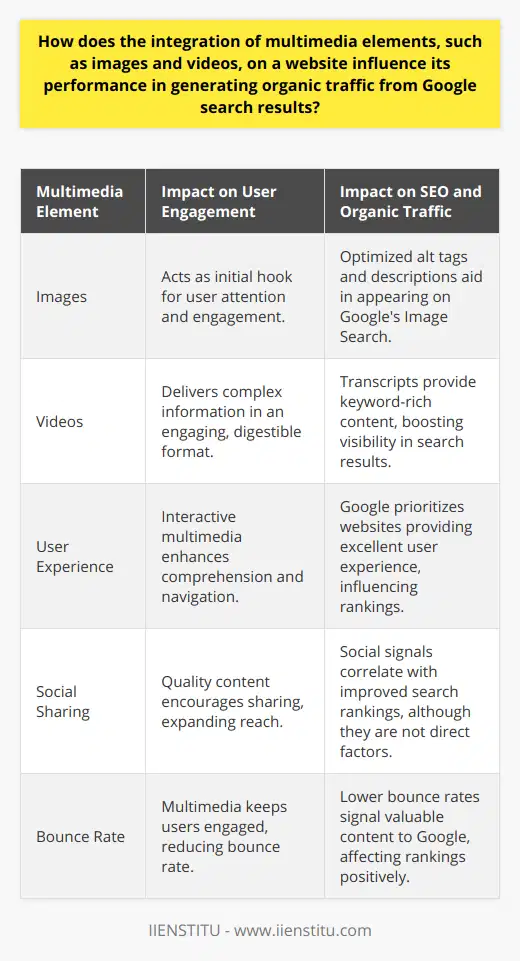
The integration of multimedia elements, such as images and videos, on a website significantly influences its performance in generating organic traffic from Google search results. The use of multimedia content can enhance user engagement and provide added value for visitors, thereby increasing the likelihood of attracting more users through search engine queries.
Visual Content Enhancement
Images and videos help make a website more visually appealing, leaving a positive impression on users. This high-quality content encourages visitors to remain on the site, ultimately reducing the bounce rate, which is an important factor affecting search engine rankings. Consequently, great multimedia content communicates the main ideas more effectively, appealing to a wider audience and leading to higher organic traffic.
Improved Search Engine Optimization
By correctly optimizing multimedia elements, including the use of descriptive file names, alt tags, captions, and XML sitemaps, it becomes easier for search engines to index and understand the content. As a result, properly optimized images and videos increase the likelihood of ranking higher in search engine results, thus driving organic traffic to a website.
Enhanced User Experience
Multimedia integration delivers a richer user experience, especially when the content seamlessly complements the text. This user-centered design approach enhances the overall user interface, making the website more intuitive for visitors. As search algorithms prioritize user experience, this added layer of interactivity boosts organic traffic from Google search results.
Increased Content Shareability
The incorporation of visually engaging images and videos into blog posts increases the likelihood that users will share the content on social media platforms. These shares essentially act as backlinks, adding credibility to the site, and signaling to search engines that the content is valuable. Consequently, shareable multimedia content improves overall search rankings, thus driving organic traffic from Google.
In conclusion, effectively integrating multimedia elements such as images and videos on a website leads to an enhanced user experience, improved search engine optimization, increased content shareability, and ultimately, better performance in generating organic traffic from Google search results.