

1. Home
  2. Blog
  3. Unlock Your SEO Potential with Spreadsheets

Unlock Your SEO Potential with Spreadsheets

David LipperDavid Lipper
January 29, 2023
Updated: March 13, 2024
12 min read
Unlock Your SEO Potential with Spreadsheets

I still remember the day when I was swamped with data, staring blankly at my computer screen, feeling utterly overwhelmed. Spreadsheets were just an intimidating grid of cells and formulas that seemed like an alien language to me. But as I delved deeper into my work, I realized that mastering spreadsheets wasn't just an option—it was a necessity. And let me tell you, the journey from confusion to confidence was transformative.

Loading...
  • Introduction

  • Why SEO Practitioners Rely on Spreadsheets

  • Spreadsheet Skills You Need to Know

  • Investing in Training

  • Conclusion

The Unsung Hero: Why Practitioners Rely on Spreadsheets

In today's fast-paced world, professionals across various fields depend heavily on spreadsheets. Whether you're an SEO practitioner, a financial analyst, or a project manager, spreadsheets are your trusty sidekick. They're not just about numbers and data; they're about making sense of complex information and unlocking insights that drive decisions.


  • Seo Escape Clause Strategy

  • Diverse Backlink Profile For Seo

  • Benefits Of Hiring An Seo Consultant


Think about it—spreadsheets help us:

1- Organize vast amounts of data: From client information to project timelines, everything finds a place.

2- Analyze trends and patterns: By applying formulas and functions, we uncover hidden gems in data.

3- Visualize information: Charts and graphs turn raw numbers into stories that are easy to comprehend.

4- Collaborate with teams: Shared spreadsheets keep everyone on the same page, quite literally.

5- Forecast and plan: Predictive models and what-if analyses aid in strategic planning.

It's no wonder that spreadsheets are an essential tool in our professional toolkit. They offer versatility and power that's hard to match.


  • How To Use Google Search Console For Seo Optimization

  • Seo Strategies For Onebox Optimization

  • Best Tools To Grow Your Blog


My Personal Journey with Spreadsheets

When I first started in digital marketing, I underestimated the importance of spreadsheets. One day, my manager asked me to present a report on our website's performance metrics. Panic set in. I had all the data but no idea how to present it effectively. That's when a colleague introduced me to the magic of pivot tables and conditional formatting.


  • SEO for Private Indexes: A Guide

  • Why Should You Work With A SEO Consultant?

  • How to Score SEO Relevancy: A Guide

  • SEO: Benefits of a Static IP Address


Suddenly, the data came alive. I could slice and dice the information in ways I never imagined. The presentation was a hit, and I realized that mastering spreadsheets wasn't just about handling data—it was about communicating insights.

Spreadsheet Skills You Need to Know

To harness the full potential of spreadsheets, there are key skills every practitioner should master:

1. Basic Navigation and Data Entry

Understanding how to efficiently move around the spreadsheet, enter data, and use basic functions is foundational.

2. Formulas and Functions

The organization is the key to unlocking your SEO Potential; spreadsheets are the perfect tool to get you there.
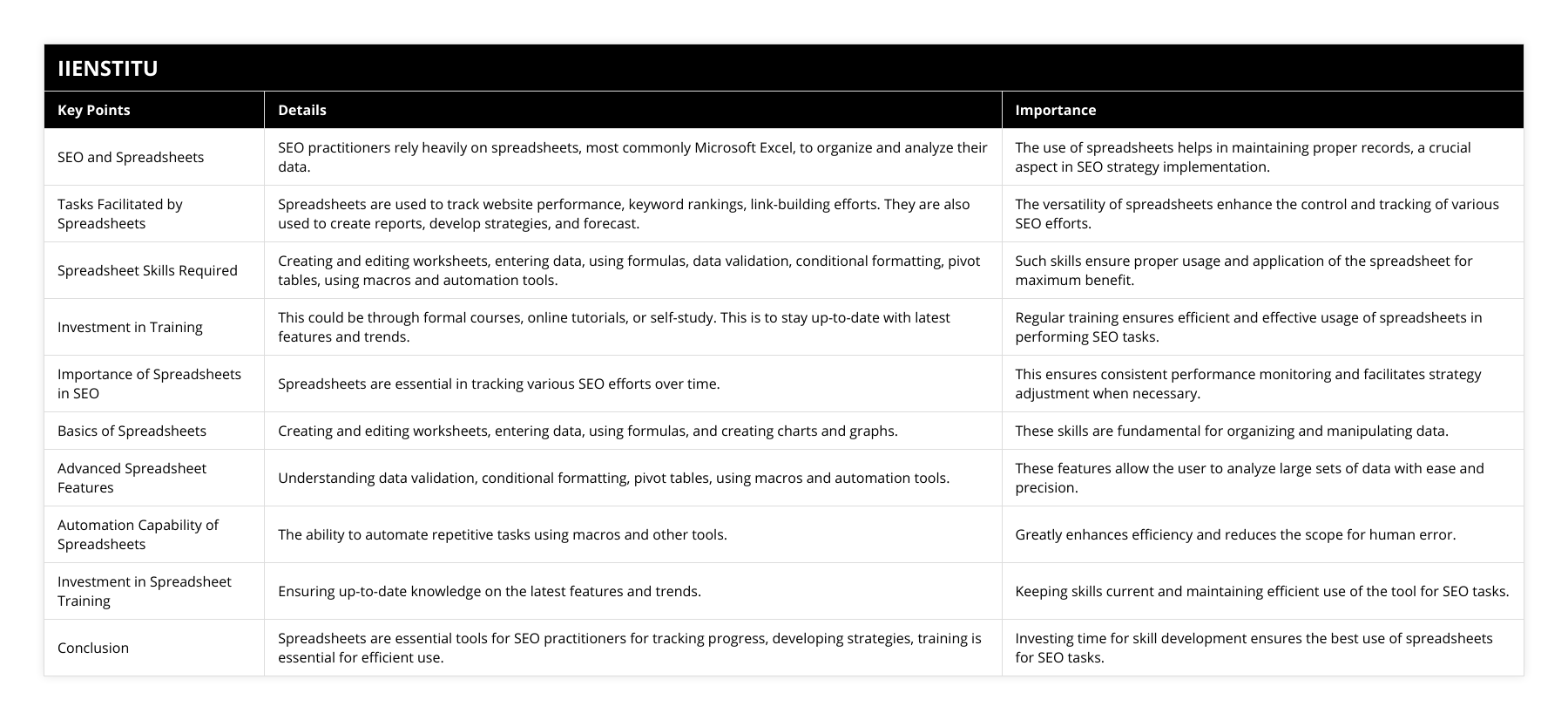
SEO and Spreadsheets, SEO practitioners rely heavily on spreadsheets, most commonly Microsoft Excel, to organize and analyze their data, The use of spreadsheets helps in maintaining proper records, a crucial aspect in SEO strategy implementation, Tasks Facilitated by Spreadsheets, Spreadsheets are used to track website performance, keyword rankings, link-building efforts They are also used to create reports, develop strategies, and forecast, The versatility of spreadsheets enhance the control and tracking of various SEO efforts, Spreadsheet Skills Required, Creating and editing worksheets, entering data, using formulas, data validation, conditional formatting, pivot tables, using macros and automation tools, Such skills ensure proper usage and application of the spreadsheet for maximum benefit, Investment in Training, This could be through formal courses, online tutorials, or self-study This is to stay up-to-date with latest features and trends, Regular training ensures efficient and effective usage of spreadsheets in performing SEO tasks, Importance of Spreadsheets in SEO, Spreadsheets are essential in tracking various SEO efforts over time, This ensures consistent performance monitoring and facilitates strategy adjustment when necessary, Basics of Spreadsheets, Creating and editing worksheets, entering data, using formulas, and creating charts and graphs, These skills are fundamental for organizing and manipulating data, Advanced Spreadsheet Features, Understanding data validation, conditional formatting, pivot tables, using macros and automation tools, These features allow the user to analyze large sets of data with ease and precision, Automation Capability of Spreadsheets, The ability to automate repetitive tasks using macros and other tools, Greatly enhances efficiency and reduces the scope for human error, Investment in Spreadsheet Training, Ensuring up-to-date knowledge on the latest features and trends, Keeping skills current and maintaining efficient use of the tool for SEO tasks, Conclusion, Spreadsheets are essential tools for SEO practitioners for tracking progress, developing strategies, training is essential for efficient use, Investing time for skill development ensures the best use of spreadsheets for SEO tasks

From simple calculations to complex logical tests, formulas are the heart of spreadsheet functionality. Some essential functions include:

SUM, AVERAGE, MIN, MAX: Basic calculations for data sets.

VLOOKUP and HLOOKUP: Searching for specific data points.

IF, AND, OR: Logical functions that allow for decision-making processes within data.

3. Data Visualization

Creating charts and graphs helps in presenting data compellingly. Knowing when to use a bar graph versus a pie chart can make all the difference.

4. Pivot Tables

These are powerful tools for summarizing large data sets. Pivot tables allow you to quickly analyze and interpret complex data.

5. Data Validation and Conditional Formatting

Ensuring data integrity with validation rules, and highlighting important information through conditional formatting, enhances data quality and readability.

6. Macros and Automation

For repetitive tasks, macros save time and reduce errors by automating processes.

By investing time in learning these skills, you not only increase your efficiency but also your value as a professional.

The Intersection of Spreadsheets and Personal Development

You might wonder, how do spreadsheets relate to personal goals? Well, let me share an insight I've gained over the years. Just as we use spreadsheets to organize and analyze professional data, we can apply similar principles to our personal lives.

How to Use NLP Techniques to Achieve Personal Goals

Neuro-Linguistic Programming (NLP) offers strategies for understanding and influencing human behavior. When combined with the organizational power of spreadsheets, you have a formidable toolkit for personal development.

Here's how:

Setting Clear Goals: Use spreadsheets to list your goals, breaking them down into specific, measurable, achievable, relevant, and time-bound (SMART) objectives.

Tracking Progress: Regularly update your spreadsheet to monitor your advancement towards each goal.

Analyzing Patterns: Identify habits or patterns that help or hinder your progress.

Visual Representation: Create charts to visualize your journey, reinforcing motivation.

By integrating NLP techniques with spreadsheet planning, you create a structured path towards achieving your personal aspirations.

Investing in Training: A Wise Decision

Early in my career, I decided to take a comprehensive course on advanced spreadsheet techniques. At first, I was hesitant to invest both time and money. But looking back, it was one of the best decisions I've made. The training not only enhanced my technical skills but also boosted my confidence.

Here's why investing in training is crucial:

Keeps You Up-to-Date: Software is constantly evolving. Training ensures you're aware of the latest features and best practices.

Improves Efficiency: Learning shortcuts and advanced functions saves time.

Enhances Problem-Solving Skills: With deeper knowledge, you're better equipped to tackle complex tasks.

Increases Employability: Proficiency with spreadsheets is a highly sought-after skill in many industries.

Remember, education isn't just an expense; it's an investment in yourself.

Practical Tips for Mastering Spreadsheets

If you're ready to dive in, here are some steps to get you started:

1- Enroll in a Course: Find a reputable class or workshop. Look for those that offer hands-on experience.

2- Practice Regularly: Like any skill, practice is key. Set aside time each week to work on exercises.

3- Join a Community: Online forums and local groups can provide support and answer questions.

4- Apply Learnings Immediately: Use your new skills in real-world projects to reinforce learning.

5- Stay Curious: Technology changes rapidly. Keep exploring new functions and features.

The Broader Impact: From Professional to Personal Growth

Mastering spreadsheets isn't just about enhancing your resume. It's about developing a mindset of continuous improvement and attention to detail. These qualities spill over into other areas of life, fostering growth and success.

For example, organizing your personal finances with spreadsheets can lead to better money management. Planning a vacation? Spreadsheets can help you budget, schedule, and maximize your enjoyment.

Conclusion

Embracing spreadsheets transformed my professional life, and it can do the same for you. From boosting efficiency at work to achieving personal goals through NLP techniques combined with structured planning, the benefits are vast.

Organization is the key to unlocking your potential; spreadsheets are the perfect tool to get you there. So, don't shy away from those grids and cells. Dive in, explore, and watch as a world of possibilities unfolds.


References

Smith, J. (2018). Mastering Excel: A Comprehensive Guide to Advanced Spreadsheet Techniques. New York: TechPress.

Johnson, L. (2015). Data Analysis for Professionals. London: Academic Publishing.

Martinez, R. (2019). The Power of Visualization in Data. Sydney: Informative Books.

Thompson, A. (2017). Neuro-Linguistic Programming: A Practical Guide to Personal Transformation. Toronto: MindWorks Publications.

Williams, K. (2020). Efficiency in the Workplace: Tools and Techniques. Chicago: Productivity Press.

These resources have been instrumental in my journey, and I highly recommend them to anyone looking to enhance their skills.


Ready to take the next step? Grab a spreadsheet, set your goals, and begin your journey towards personal and professional excellence. After all, the only limit is the one you set for yourself.

Frequently Asked Questions

What are the benefits of using spreadsheets for SEO?

Spreadsheets are a valuable tool for organizing and managing information relevant to SEO. Using a spreadsheet for SEO can help to keep track of data, stay organized, and streamline workflows.

Regarding SEO, spreadsheets can store and analyze data, such as keywords, rankings, and website traffic. This can help to track progress over time and identify areas of improvement. Spreadsheets can also be used to create a content calendar, plan campaigns, and track success metrics.

In addition, spreadsheets can be used to organize and store website audits. This can help to identify any issues and prioritize tasks when it comes to optimizing a website. Spreadsheets can also be used to track and monitor external and internal links. This can help to ensure that all links are working correctly and that any broken links are quickly addressed.

Spreadsheets can also be used to analyze competitor data. This can be useful for identifying successful SEO techniques and understanding how competitors rank for specific keywords. By analyzing competitor data, it is possible to develop strategies to gain an edge over competitors and rank higher in search engine results.

Finally, spreadsheets can be used to organize and store data related to reporting and analytics. This can help to summarize data in a convenient and easy-to-understand format. Spreadsheets can also be used to create automated reports that can be used to provide updates to clients and stakeholders.

In conclusion, spreadsheets are an effective tool for organizing and managing data related to SEO. Spreadsheets can help to track progress and identify areas of improvement, create content calendars, plan campaigns, and analyze competitor data. In addition, spreadsheets can be used to store website audits, track links, and generate reports and analytics. For these reasons, spreadsheets are a valuable tool for SEO.
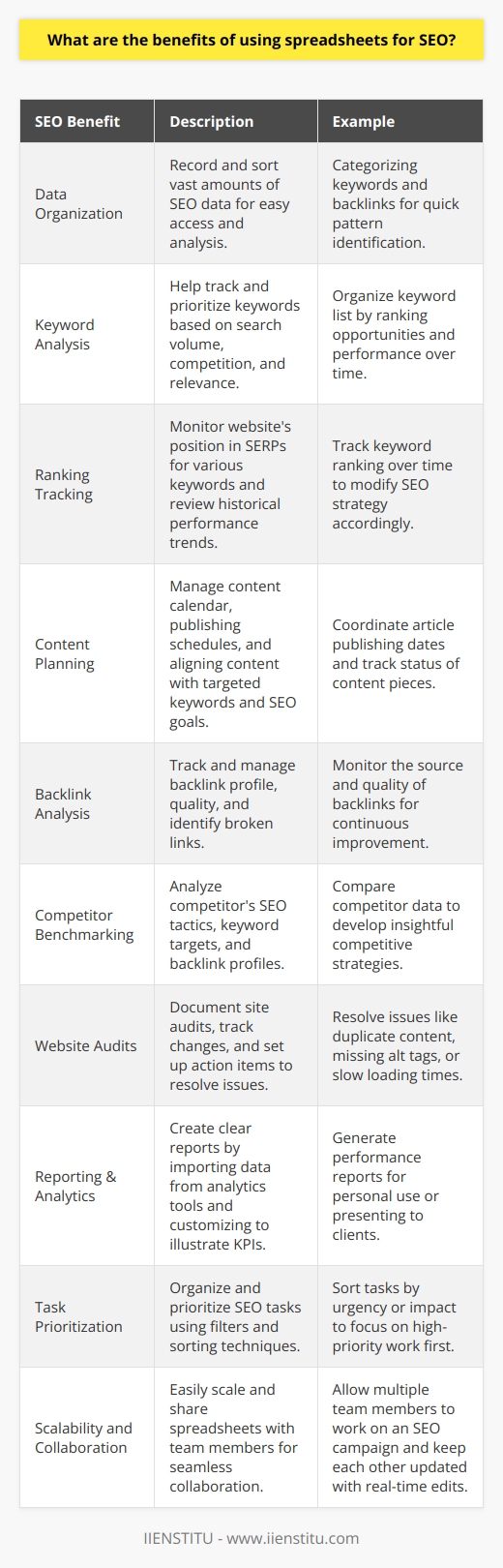
Search Engine Optimization (SEO) is an essential part of digital marketing, and managing the vast amount of data involved in SEO campaigns requires precision and organization. Enter the humble spreadsheet – a surprisingly powerful tool for anyone serious about SEO. Here’s how spreadsheets can benefit your SEO efforts:1. Data Organization: Spreadsheets allow you to meticulously record and sort vast amounts of SEO data. From keywords to backlinks, every piece of data can be categorized for easy access and analysis. By maintaining a well-structured database of your SEO metrics, you can quickly identify patterns and areas that need attention.2. Keyword Analysis: Keywords are the cornerstone of SEO. Spreadsheets can be instrumental in keyword research, helping to track search volume, competition, and performance over time. They also enable SEO specialists to organize and prioritize keywords based on relevance and opportunities for ranking.3. Ranking Tracking: Keep an eye on your website's position in the Search Engine Results Pages (SERPs) for various keywords. By using a spreadsheet, you can monitor historical data to review performance trends and modify your SEO strategy accordingly.4. Content Planning: Spreadsheets are excellent for planning and managing a content calendar. They can help coordinate publishing schedules, track the status of content pieces, and align them with targeted keywords and SEO goals.5. Backlink Analysis: Track and manage your backlink profile using spreadsheets. Understanding where your links come from, tracking the quality of these links, and identifying broken links is much easier when you have an organized spreadsheet at your disposal.6. Competitor Benchmarking: A strategic approach to SEO often involves keeping an eye on the competitors. Spreadsheets can be used to accumulate, compare, and analyze data about competitors' SEO tactics, including their keyword targets and backlink profiles, enabling the development of insightful competitive strategies.7. Website Audits: Technical SEO requires regular website audits. Spreadsheets are ideally suited for documenting site audits, tracking changes, and setting up action items to resolve issues, such as duplicate content, missing alt tags, or slow loading times.8. Reporting & Analytics: Whether it's for personal use or presenting to clients, spreadsheets provide a means to create clear, digestible reports. Data pulled from analytics tools can be imported into a spreadsheet and customized to illustrate key performance indicators (KPIs) that matter most.9. Task Prioritization: SEO involves a multitude of tasks, and spreadsheets help prioritize these. By using filters and sorting techniques, you can organize tasks by urgency or impact, making sure high-priority work is carried out first.10. Scalability and Collaboration: As your SEO efforts expand, spreadsheets can be easily scaled and shared with team members, allowing for seamless collaboration. Different team members can work on various aspects of the SEO campaign simultaneously and keep each other updated with real-time editing capabilities.Overall, the beauty of using spreadsheets for SEO lies in their flexibility, simplicity, and ability to corral complex information into an actionable format. Whether you are tracking the latest keyword trends, auditing your website for on-page SEO, monitoring competitor strategies, or compiling sophisticated performance reports, spreadsheets provide a customizable and comprehensive solution to manage the multitude of tasks associated with an effective SEO strategy.
What spreadsheet skills do SEO practitioners need to know?

Spreadsheet skills are becoming increasingly important for SEO practitioners to understand and master. Spreadsheet analysis is a fundamental part of the SEO process and is used to identify, track, and analyze a website’s performance over time. By having a solid understanding of spreadsheet skills, SEO practitioners can better evaluate their strategies' effectiveness, identify improvement opportunities, and ensure they are getting the most value from their efforts.

One of the essential spreadsheet skills for SEO practitioners is the ability to collect, organize, and analyze large amounts of data. This includes sorting and filtering data, creating charts, and using formulas to calculate values. By gathering various data points from sources such as Google Analytics, Search Console, and other third-party tools, SEO practitioners can gain valuable insights into the performance of their website, as well as potential areas of improvement.

Another important spreadsheet skill is the ability to create pivot tables. Pivot tables are a powerful tool that can quickly summarize and analyze large amounts of data. They can identify trends, track progress over time, and compare performance between different metrics. By understanding how to use pivot tables, SEO practitioners can better understand their website's performance and identify areas for optimization.

Finally, SEO practitioners should be familiar with data visualization tools. Data visualization tools allow for the easy creation of bar graphs, pie charts, line graphs, and other types of visuals. With these tools, SEO practitioners can quickly and easily identify changes in performance over time, compare performance between different metrics, and identify correlations between data points.

By understanding and mastering spreadsheet skills, SEO practitioners can gain valuable insights into the performance of their website, identify areas of improvement, and ensure they are getting the most value from their efforts. Spreadsheet analysis is an essential part of the SEO process, and understanding how to use the various tools available can help SEO practitioners maximize their results.
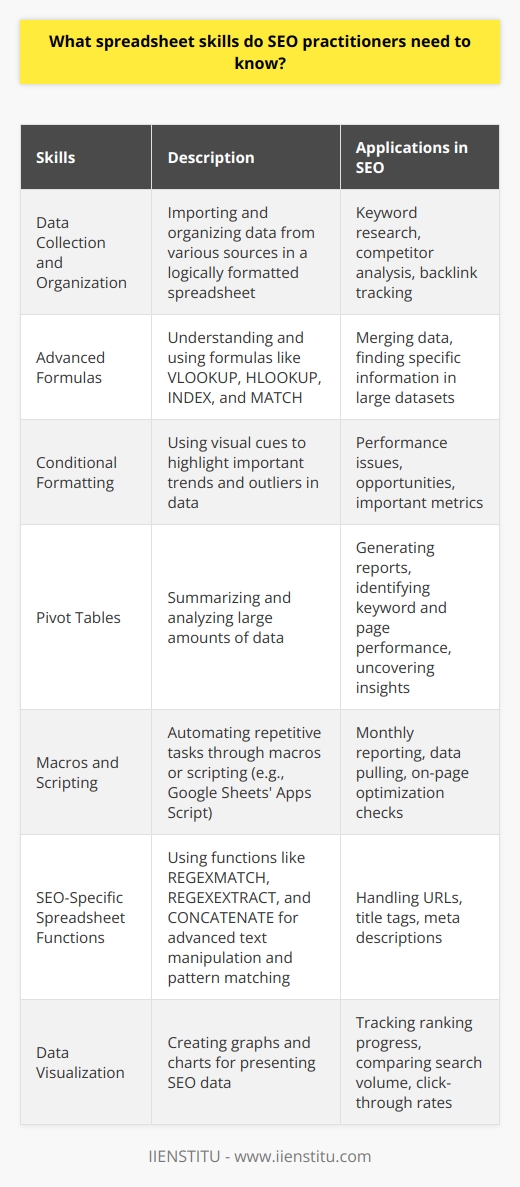
As the field of Search Engine Optimization (SEO) becomes increasingly data-driven, the need for SEO practitioners to possess advanced spreadsheet skills is becoming more critical. In the realm of SEO, spreadsheets are indispensable for performing a variety of tasks including keyword research, competitor analysis, backlink tracking, and reporting on SEO metrics. Here's a list of key spreadsheet skills that can give SEO practitioners an edge:1. Data Collection and Organization: SEO professionals must be adept at importing data from multiple sources such as CSV files, website crawlers, and SEO tools. Organizing this data in a spreadsheet in a logical and accessible manner allows for easy analysis and decision-making. For instance, categorizing keywords by search volume, competition, and relevance can help in prioritizing SEO strategies.2. Advanced Formulas: Beyond the basic SUM and AVERAGE, understanding advanced formulas like VLOOKUP, HLOOKUP, INDEX, and MATCH can significantly reduce the time spent on data manipulation. These formulas are helpful for merging data from different sources or finding specific information across large datasets, which is a common need in SEO tasks.3. Conditional Formatting: Visual cues can quickly draw attention to important trends and outliers in SEO data. Conditional formatting can be used to highlight performance issues, opportunities, and important metrics in a data set, thus enabling SEO professionals to take timely actions.4. Pivot Tables: SEO practitioners should master pivot tables for summarizing and analyzing large amounts of SEO data. It helps in quickly generating reports, identifying the performance of various keywords and pages, and uncovering insights that drive SEO strategy. Pivot tables are powerful for segmenting data and finding relationships between different SEO variables.5. Macros and Scripting: Automating repetitive tasks through macros or scripting (e.g., Google Sheets' Apps Script) saves time and reduces the potential for human errors. Knowledge of basic automation allows SEO practitioners to streamline processes like monthly reporting, data pulling, and even on-page optimization checks.6. SEO-Specific Spreadsheet Functions: A familiarity with functions that are particularly useful in SEO analysis, such as REGEXMATCH, REGEXEXTRACT, and CONCATENATE, can provide a competitive advantage. These functions enable advanced text manipulation and pattern matching, which can be essential when dealing with URLs, title tags, and meta descriptions.7. Data Visualization: Graphs and charts are vital for presenting SEO data in an easily digestible format. SEO practitioners must be able to create visualizations such as line charts for tracking ranking progress, bar charts for comparing search volume, or heat maps for click-through rates on a page. Graphical representations often make it easier to communicate SEO performance to clients or stakeholders.By mastering these spreadsheet skills, SEO practitioners from institutions like IIENSTITU can enhance their analytical capabilities and deliver more impactful SEO strategies. Proficiency in spreadsheets enables SEO professionals to efficiently manage the wealth of data that comes with optimizing websites for search engines and derive actionable insights to stay ahead in the competitive SEO landscape.
How can investing in training help unlock SEO potential with spreadsheets?

Investing in training can help unlock the potential of search engine optimization (SEO) through spreadsheets. Spreadsheets provide an effective and efficient way to track and analyze website performance, including tracking and measuring keyword performance, backlinks, and rankings. By investing in training, businesses can learn the fundamentals of SEO and how to use spreadsheets to their advantage.

Spreadsheet tools such as Microsoft Excel and Google Sheets provide a convenient way to organize and analyze large amounts of data. With spreadsheets, users can track keyword performance and compare rankings over time. They can also identify patterns in backlinks or other metrics that might lead to improved website rankings. By tracking keyword performance, businesses can determine which keywords bring in the most traffic and adjust their strategy accordingly.

In addition to tracking keyword performance, spreadsheets help identify link-building opportunities and monitor backlinks. Link building is essential to SEO, as it helps increase website visibility and improve rankings. Spreadsheets can be used to track links, identify potential link opportunities, and monitor backlinks to ensure they are of high quality and relevant to the website’s content.

Businesses that invest in SEO training can also learn how to use spreadsheets to analyze data and make informed decisions. Through training, companies can learn how to use formulas to calculate metrics such as keyword density and keyword frequency. They can also learn how to use pivot tables to analyze data and identify opportunities for improvement.

Investing in training can help unlock the potential of SEO through the use of spreadsheets. Businesses can improve their website rankings and increase visibility by understanding how to use spreadsheets to analyze data, identify opportunities, and track performance. With the proper training, businesses can become more efficient and effective at SEO, leading to improved website performance.
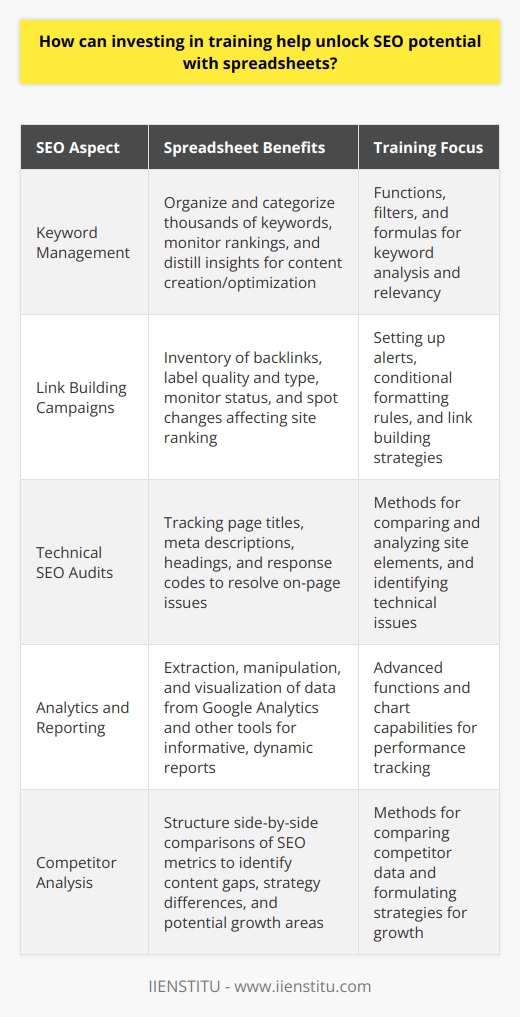

Investing in SEO training, particularly when focused on the application of spreadsheets for SEO tasks, offers companies the tools to fine-tune their websites for better search engine visibility, user engagement, and overall performance. Spreadsheet skills are often overlooked in the SEO world but can provide immense benefits for data organization, analysis, and strategic planning.Spreadsheets like Microsoft Excel or Google Sheets become powerful allies in handling vast arrays of SEO data. With training, individuals can harness their capabilities to create a structured repository of information related to keywords, backlinks, content audits, competitor analysis, and more.The keyword is the heart of SEO. Proper training can help individuals learn how to input and categorize thousands of keywords within spreadsheets, monitor their rankings, search volumes, and relevancy to different pages on a website. By mastering the use of functions and filters, SEO professionals can distill large keyword lists into actionable insights for content creation or optimization.Link building campaigns benefit significantly from spreadsheet use. Training can guide individuals on how to keep an inventory of backlinks, label the quality and type of each link, and continuously monitor their status. By setting up alerts or conditional formatting rules within a spreadsheet, SEO professionals can quickly spot changes that could affect their site's ranking.Similarly, technical SEO audits can be streamlined with spreadsheets. Training might include methods for tracking page titles, meta descriptions, headings, and response codes across a site, enabling an SEO specialist to identify and resolve any on-page issues quickly.Analytics and reporting are other areas where spreadsheets excel. SEO training often covers the extraction, manipulation, and visualization of data from Google Analytics and other tools. With advanced functions and chart capabilities, professionals can create informative, dynamic reports that track SEO performance over time.Lastly, spreadsheets are ideal for competitor analysis. With proper training, businesses can structure side-by-side comparisons of their SEO metrics with those of their competitors. This process aids in identifying content gaps, strategy differences, and potential areas for growth.In conclusion, investing in training for SEO with a focus on spreadsheets equips individuals with precise, organized methods to collect, analyze, and act upon the large amounts of data encountered in SEO work. From keyword tracking to backlink analysis, and from technical audits to competitor research, spreadsheets can empower businesses to make data-driven decisions. This leads to smarter strategies, improved ranking, and ultimately, stronger online presence and business success.

Related Articles

SEO vs SEM: What's the Difference?

SEO vs SEM: What's the Difference?

December 12, 2019
What are SEO and SEM? Which One Should You Use?

What are SEO and SEM? Which One Should You Use?

December 21, 2021
What Is Semantic SEO?

What Is Semantic SEO?

March 11, 2022
IIENSTITU LogoIIENSTITU

Professional online education platform to advance your career

Course CategoriesBlog CategoriesCorporate TrainingSupportUnsubscribePoliciesCertificate VerificationContactAbout InstitutePrivacy and Security PolicyDistance Sales ContractCancellation and Return TermsMembership Agreement
Follow Us:
figin

© 2012–2025 IIENSTITU - All rights reserved

IIENSTITU
IIENSTITU
CoursesInstructorsCertificateBlog
IIENSTITU
Login
Download CSV
Table with 10 rows and 3 columns
SEO and SpreadsheetsSEO practitioners rely heavily on spreadsheets, most commonly Microsoft Excel, to organize and analyze their data.The use of spreadsheets helps in maintaining proper records, a crucial aspect in SEO strategy implementation.
Tasks Facilitated by SpreadsheetsSpreadsheets are used to track website performance, keyword rankings, link-building efforts. They are also used to create reports, develop strategies, and forecast.The versatility of spreadsheets enhance the control and tracking of various SEO efforts.
Spreadsheet Skills RequiredCreating and editing worksheets, entering data, using formulas, data validation, conditional formatting, pivot tables, using macros and automation tools.Such skills ensure proper usage and application of the spreadsheet for maximum benefit.
Investment in TrainingThis could be through formal courses, online tutorials, or self-study. This is to stay up-to-date with latest features and trends.Regular training ensures efficient and effective usage of spreadsheets in performing SEO tasks.
Importance of Spreadsheets in SEOSpreadsheets are essential in tracking various SEO efforts over time.This ensures consistent performance monitoring and facilitates strategy adjustment when necessary.
Basics of SpreadsheetsCreating and editing worksheets, entering data, using formulas, and creating charts and graphs.These skills are fundamental for organizing and manipulating data.
Advanced Spreadsheet FeaturesUnderstanding data validation, conditional formatting, pivot tables, using macros and automation tools.These features allow the user to analyze large sets of data with ease and precision.
Automation Capability of SpreadsheetsThe ability to automate repetitive tasks using macros and other tools.Greatly enhances efficiency and reduces the scope for human error.
Investment in Spreadsheet TrainingEnsuring up-to-date knowledge on the latest features and trends.Keeping skills current and maintaining efficient use of the tool for SEO tasks.
ConclusionSpreadsheets are essential tools for SEO practitioners for tracking progress, developing strategies, training is essential for efficient use.Investing time for skill development ensures the best use of spreadsheets for SEO tasks.
Key PointsSEO and Spreadsheets
DetailsSEO practitioners rely heavily on spreadsheets, most commonly Microsoft Excel, to organize and analyze their data.
ImportanceThe use of spreadsheets helps in maintaining proper records, a crucial aspect in SEO strategy implementation.
Key PointsTasks Facilitated by Spreadsheets
DetailsSpreadsheets are used to track website performance, keyword rankings, link-building efforts. They are also used to create reports, develop strategies, and forecast.
ImportanceThe versatility of spreadsheets enhance the control and tracking of various SEO efforts.
Key PointsSpreadsheet Skills Required
DetailsCreating and editing worksheets, entering data, using formulas, data validation, conditional formatting, pivot tables, using macros and automation tools.
ImportanceSuch skills ensure proper usage and application of the spreadsheet for maximum benefit.
Key PointsInvestment in Training
DetailsThis could be through formal courses, online tutorials, or self-study. This is to stay up-to-date with latest features and trends.
ImportanceRegular training ensures efficient and effective usage of spreadsheets in performing SEO tasks.
Key PointsImportance of Spreadsheets in SEO
DetailsSpreadsheets are essential in tracking various SEO efforts over time.
ImportanceThis ensures consistent performance monitoring and facilitates strategy adjustment when necessary.
Key PointsBasics of Spreadsheets
DetailsCreating and editing worksheets, entering data, using formulas, and creating charts and graphs.
ImportanceThese skills are fundamental for organizing and manipulating data.
Key PointsAdvanced Spreadsheet Features
DetailsUnderstanding data validation, conditional formatting, pivot tables, using macros and automation tools.
ImportanceThese features allow the user to analyze large sets of data with ease and precision.
Key PointsAutomation Capability of Spreadsheets
DetailsThe ability to automate repetitive tasks using macros and other tools.
ImportanceGreatly enhances efficiency and reduces the scope for human error.
Key PointsInvestment in Spreadsheet Training
DetailsEnsuring up-to-date knowledge on the latest features and trends.
ImportanceKeeping skills current and maintaining efficient use of the tool for SEO tasks.
Key PointsConclusion
DetailsSpreadsheets are essential tools for SEO practitioners for tracking progress, developing strategies, training is essential for efficient use.
ImportanceInvesting time for skill development ensures the best use of spreadsheets for SEO tasks.