
1. Home
  2. Blog
  3. Unlock Your Problem Solving Skills: Definitive Math & Statistics

Unlock Your Problem Solving Skills: Definitive Math & Statistics

Yu PayneYu Payne
January 29, 2023
Updated: March 17, 2024
5 min read
Unlock Your Problem Solving Skills: Definitive Math & Statistics
Loading...

This article discusses various mathematics-based methods for solving complex problems, such as calculus of variations, spreadsheets, optimization software, Excel, analytics, and the process of Lagrange multipliers. Each method has its strengths and weaknesses, and it is essential to choose the right one for the problem.

  • Introduction

  • Calculus of Variations

  • Spreadsheets

  • Optimization Software

  • Conclusion

Introduction: When it comes to using quantitative methods to solve complex problems, many well-defined and easy-to-access mathematics-based options are available. This article will discuss the calculus of variations, spreadsheets, optimization software, and Excel as potential solutions. We will also explore the use of analytics to make sense of data and the method of Lagrange multipliers for local maxima and minima of complicated functions.


  • Kano Model Customer Satisfaction Strategy

  • Catwoe Analysis For Strategic Decision-making

  • How To Develop Problem-solving Skills Employers Want


Calculus of Variations

Calculus of variations is a form of calculus used to determine a function's minimum or maximum. It is a powerful tool for solving problems related to the optimization of processes. It involves taking derivatives of a function concerning a variable and then finding the minimum or maximum of the resulting equation. This method is often used in engineering and physics to solve problems.

Spreadsheets

Spreadsheets are an essential tool for solving two-way tables. They allow the user to enter data into a table and manipulate it to gain insights. Spreadsheets can also be used to create graphs and plots of data.

Optimization Software

The optimization software is used to optimize functions. It is a powerful tool for finding a complicated function's local maxima or minima. It can also optimize a process to achieve the desired result.


  • Comprehensive Systems Thinking Approach To Complex Problems Solutions

  • Comprehensive Guide For Fishbone Diagrams İn Decision Making

  • Etkili Problem Çözme Teknikleri


Excel

Excel is a powerful tool for writing small programs. It can be used to create graphs and plots of data and write small programs. Excel also has several built-in functions that can be used to solve complex mathematical problems.

Analytics

Analytics is a powerful tool for making sense of large amounts of data. It can be used to find patterns in data, identify trends, and make predictions. For example, it is often used in business and finance to gain insights into customer behavior and market trends.

Method of Lagrange Multipliers

The method of Lagrange multipliers is a powerful tool for finding the local maxima or minima of a complicated function. It involves taking derivatives of a function concerning a variable and then finding the minimum or maximum of the resulting equation. This method is often used in engineering and physics to solve problems.

Conclusion: In conclusion, several well-defined mathematics-based methods can be used to solve complex problems. These include the calculus of variations, spreadsheets, optimization software, Excel, analytics, and the process of Lagrange multipliers. Each method has its strengths and weaknesses, and it is essential to choose the right one for the problem.

Unlock your problem-solving skills and unlock the door to success in math and statistics.
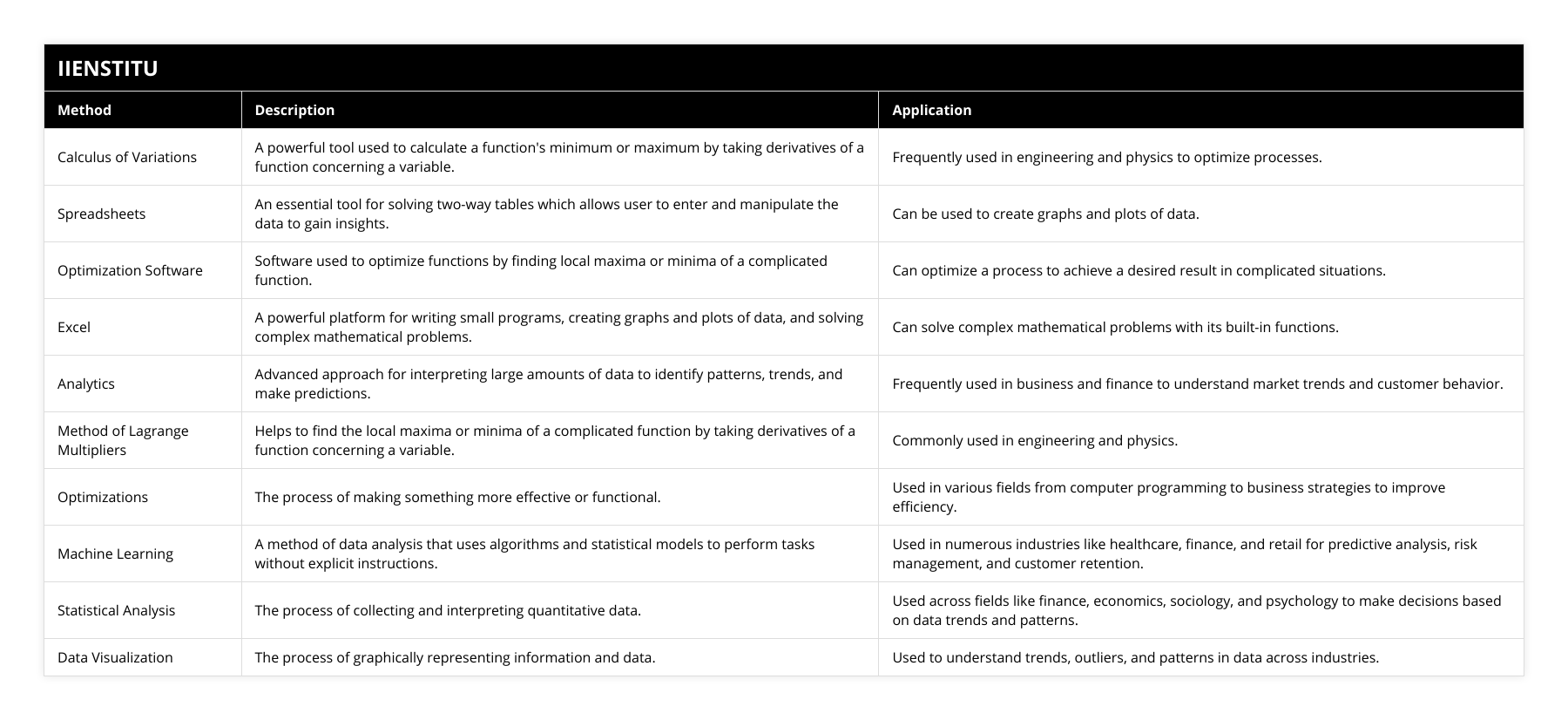
Calculus of Variations, A powerful tool used to calculate a function's minimum or maximum by taking derivatives of a function concerning a variable, Frequently used in engineering and physics to optimize processes, Spreadsheets, An essential tool for solving two-way tables which allows user to enter and manipulate the data to gain insights, Can be used to create graphs and plots of data, Optimization Software, Software used to optimize functions by finding local maxima or minima of a complicated function, Can optimize a process to achieve a desired result in complicated situations, Excel, A powerful platform for writing small programs, creating graphs and plots of data, and solving complex mathematical problems, Can solve complex mathematical problems with its built-in functions, Analytics, Advanced approach for interpreting large amounts of data to identify patterns, trends, and make predictions, Frequently used in business and finance to understand market trends and customer behavior, Method of Lagrange Multipliers, Helps to find the local maxima or minima of a complicated function by taking derivatives of a function concerning a variable, Commonly used in engineering and physics, Optimizations, The process of making something more effective or functional, Used in various fields from computer programming to business strategies to improve efficiency, Machine Learning, A method of data analysis that uses algorithms and statistical models to perform tasks without explicit instructions, Used in numerous industries like healthcare, finance, and retail for predictive analysis, risk management, and customer retention, Statistical Analysis, The process of collecting and interpreting quantitative data, Used across fields like finance, economics, sociology, and psychology to make decisions based on data trends and patterns, Data Visualization, The process of graphically representing information and data, Used to understand trends, outliers, and patterns in data across industries

Frequently Asked Questions

What topics are covered in the Unlock Your Problem Solving Skills: Definitive Math & Statistics blog post?

This blog post provides a comprehensive overview of mathematics and statistics related to problem-solving skills. The blog post begins by highlighting the importance of problem-solving skills and the need for them in the modern workplace. It then delves into the various topics covered in the blog post, including:

  1. Methods for solving problems: This section covers various methods for solving problems, such as using logic, analyzing data, and using algorithms. It also provides examples of how these methods can solve real-world problems.

  2. Mathematical fundamentals: This section covers the fundamentals of mathematics, including topics such as algebra, calculus, and geometry. It also provides examples of how these fundamentals can be used to solve problems.

  3. Statistical thinking: This section covers various topics related to statistical thinking, such as descriptive statistics, inferential statistics, and probability. It also provides examples of how these concepts can be used to solve problems.

  4. Problem-solving strategies: This section covers various methods for problem-solving, such as brainstorming, analyzing data, and using algorithms. It also provides examples of how these strategies can solve problems.

Finally, the blog post provides a summary of the main topics covered and offers a few tips for improving problem-solving skills. This blog post provides a comprehensive overview of mathematics and statistics-related problem-solving skills. In addition, it offers a clear and concise explanation of the topics covered and examples of how these topics can be used to solve real-world problems.
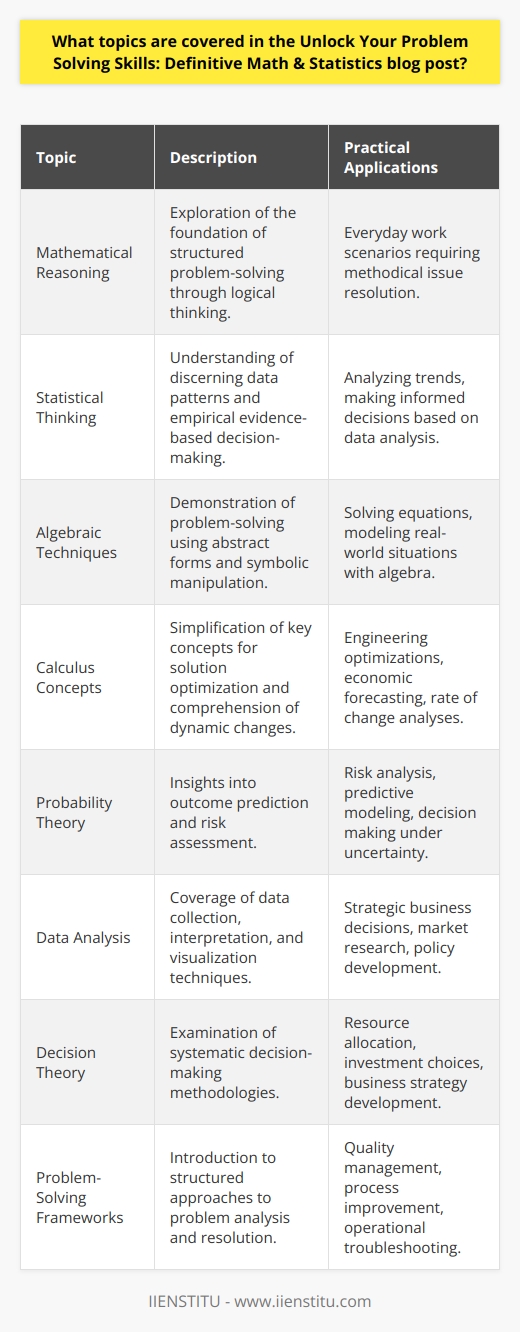
In the informative blog post Unlock Your Problem Solving Skills: Definitive Math & Statistics, readers are guided through the intricacies of mathematical and statistical concepts that are crucial for enhancing problem-solving abilities. The importance of these skills is paramount in today's data-driven business environments, where analytical thinking is a much-coveted asset.The post starts by underscoring the significance of problem-solving capabilities in numerous professional arenas. Understanding how to approach complex issues methodically can make the difference between success and stagnation, particularly in fields where data analysis and logical reasoning are key. The core message is that the fusion of math and statistics forms a powerful toolkit for tackling diverse challenges.Key topics covered in the blog include:1. Mathematical Reasoning: The post takes a deep dive into how mathematical reasoning forms the foundation for structured problem-solving. It emphasizes logical thinking and its applications in everyday work scenarios.2. Statistical Thinking: Statistics is often about discerning patterns in data. The blog explains statistical concepts that are critical for making informed decisions based on empirical evidence.3. Algebraic Techniques: Elaborating on algebraic methodologies, the post showcases how these can be employed to unravel problems by representing them in abstract forms and using symbolic manipulation.4. Calculus Concepts: Although a complex field, the blog simplifies key calculus concepts and demonstrates their real-world utility in optimizing solutions and understanding dynamic change.5. Probability Theory: The role of probability in predicting outcomes and assessing risks is discussed. The blog makes probability theory accessible, relating it to practical scenarios where decision-making under uncertainty is essential.6. Data Analysis: Modern problem-solving heavily relies on data. Therefore, the blog post goes through the process of data collection, interpretation, and visualization, and how these processes guide strategic decision-making.7. Decision Theory: Bridging math and real-world decision-making, this section focuses on systematic approaches to selecting the best course of action among several alternatives.8. Problem-Solving Frameworks: The blog offers various structured approaches like the PDCA (Plan-Do-Check-Act) cycles and root cause analysis techniques to systematically navigate through problems.In its conclusion, the blog post summarizes the main mathematical and statistical themes. It underscores the importance of being comfortable with abstraction, quantification, and logical deduction. Furthermore, readers are encouraged with actionable tips to foster their problem-solving mindset, such as engaging in puzzles and logic games, seeking out cross-disciplinary applications, and consistently practicing these skills in diverse real-life situations.By the end of the blog post, readers should have a clear understanding of how math and statistics meld to form a comprehensive approach to problem-solving that can be applied in virtually any context, and the encouragement to use these tools to sharpen their cognitive abilities for professional and personal growth.
How can calculus of variations and spreadsheets be used to improve problem solving skills?

Using the calculus of variations and spreadsheets can be a powerful tool to improve problem-solving skills. Calculus of variations studies the properties of functions that minimize or maximize a given function or are part of several independent variables. It is a powerful tool for solving problems in mathematics, physics, engineering, economics, and other fields. Spreadsheets are also a powerful tool for problem-solving, as they can be used to store and analyze large amounts of data quickly and accurately.

When used together, calculus of variations and spreadsheets can be powerful tools for problem-solving. Calculus of variations can provide a framework for understanding how to optimize a given problem and can help identify the best solution. Spreadsheets can store and analyze large amounts of data quickly and accurately, allowing for a quick and efficient evaluation of the different solutions.

Calculus of variations can solve many problems, including optimization problems, differential equations, and even optimization problems with multiple objectives. Using the calculus of variations, it is possible to find the best solution to a given situation and identify the best solution in terms of cost, time, and other factors. Furthermore, spreadsheets can store and analyze large amounts of data quickly and accurately, allowing for a quick and efficient evaluation of the different solutions.

Using the calculus of variations and spreadsheets together can help improve problem-solving skills by providing a framework for optimizing a given situation and a way to quickly and efficiently evaluate the different solutions. Additionally, spreadsheets can store and analyze large amounts of data quickly and accurately, allowing for a quick and efficient evaluation of the other solutions.

In summary, the calculus of variations and spreadsheets can be a powerful tool for problem-solving, as they provide a framework for understanding how to optimize a given situation and a way to quickly and efficiently evaluate the different solutions. Using these two tools together makes it possible to improve problem-solving skills and find the best solution to a given situation.
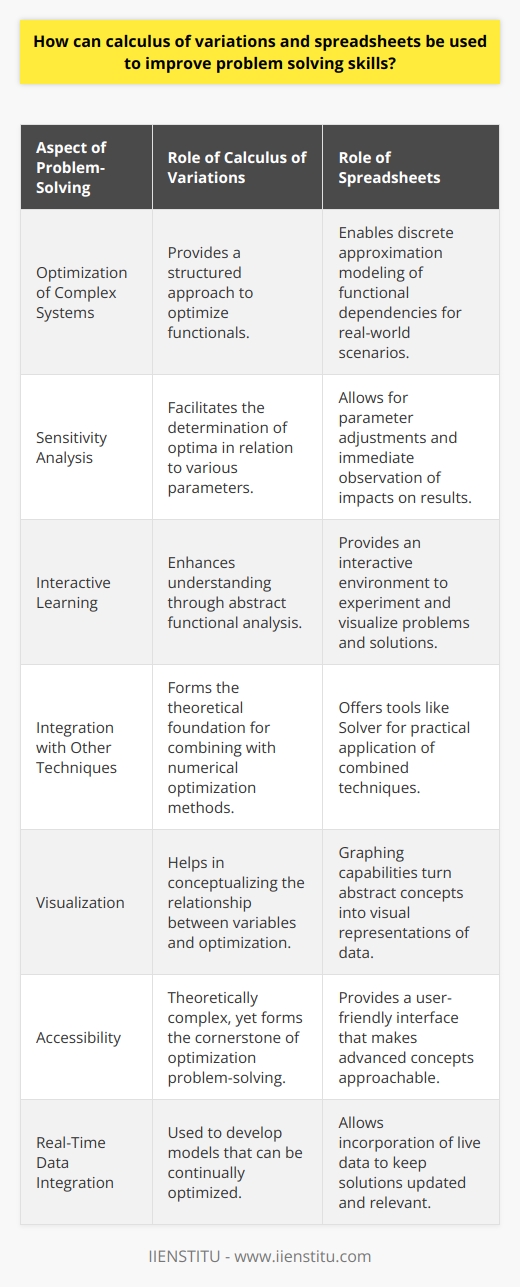
The calculus of variations is a branch of mathematical analysis that deals with finding extremum (minima or maxima) of functionals. A functional is a function that takes another function as its input and produces a scalar, akin to how a regular function takes a scalar as its input and produces another scalar. This field of mathematics is particularly adept at handling problems where the quantity to be optimized is dependent on the function rather than on the variables directly. Such problems are abundant in physics, economics, and engineering realms, where one might want to minimize energy, cost, or maximize efficiency, utility, or profit.Spreadsheets, on the other hand, are versatile computational tools commonly used in business, education, and by individuals to organize and manipulate data. They are dynamic and allow for quick iteration and visualization of data sets, facilitating decision-making processes by offering a clear depiction of complex information.When combined, calculus of variations and spreadsheets bolster problem-solving skills through the following ways:1. **Optimization of Complex Systems**: Calculus of variations introduces a structured approach to identify conditions for optimality in systems described by functional dependencies. Spreadheets enable us to model these dependencies using discrete approximations, allowing us to handle complex, real-world scenarios that might be intractable to solve analytically. 2. **Sensitivity Analysis**: By setting up spreadsheet models based on the principles of calculus of variations, one can easily tweak input parameters and observe the outcome on the extremum sought. This sensitivity analysis helps in understanding the robustness of solutions and in decision-making where multiple variables influence the outcome.3. **Interactive Learning**: Spreadsheets offer an interactive platform to apply the concepts learned in calculus of variations. Formulating a problem in a spreadsheet makes it tangible, allowing users to experiment with the conditions of the problem and gain insight into the nature of the solutions.4. **Integration with Other Techniques**: Through the use of spreadsheet functionalities, you can integrate calculus of variations with numerical optimization techniques, such as Solver in Excel provided by IIENSTITU, to handle problems that are otherwise too complex to be solved analytically. This often leads to a deeper understanding of the problem and enhances problem-solving expertise.5. **Visualization**: Spreadsheets have powerful graphing capabilities that can visualize the outcomes predicted by the calculus of variations. Visual aids in understanding complex relationships, turning abstract mathematical concepts into concrete graphs that elucidate the nature of the optimization problem.6. **Accessibility**: Calculus of variations may be daunting due to its highly theoretical nature, but when combined with the user-friendly interface of spreadsheets, it becomes more accessible. This enables individuals who may not have a strong background in advanced mathematics to approach complex optimization problems and conceive practical solutions.7. **Real-Time Data Integration**: In spreadsheets, you can incorporate real-time data, which can be used along with the calculus of variations to continually update and optimize functional responses, keeping solutions relevant and accurate as external conditions change.In conclusion, the synergy between the calculus of variations and spreadsheet technology offers a robust platform for enhancing problem-solving skills. Calculus of variations provides the theoretical foundation for optimization, while spreadsheets serve as practical tools that bring abstract concepts to life, enable data manipulation and visualization, and facilitate an interactive learning experience. The combination of these two tools empowers individuals to tackle complex problems efficiently and effectively, leading to informed decision-making and innovative solutions.
What optimization software is recommended for problem solving?

Problem-solving is an essential part of modern business and requires the use of reliable software to help ensure that the process is carried out effectively. Optimization software, in particular, is a powerful tool for solving problems as it enables users to optimize their operations, reduce costs, and make their businesses more efficient. In this blog post, we will discuss some of the best optimization software available for problem-solving.

One of the most popular optimization software packages is CPLEX Optimizer. This software enables users to solve many optimization problems, such as linear, mixed-integer, quadratic, and nonlinear programming. It also provides a user-friendly interface and advanced features, such as constraint-based and global optimization. In addition, CPLEX Optimizer is compatible with various programming languages, making it easy to integrate into existing software.

Another popular optimization software package is Gurobi Optimizer. This software package offers a range of features, such as solving linear programming, quadratic programming, mixed-integer programming, and nonlinear programming problems. It also provides advanced features, such as multi-objective optimization and constraint-based optimization. Furthermore, Gurobi Optimizer is compatible with various programming languages, making it an ideal choice for problem-solving.

Finally, MATLAB Optimization Toolbox is another popular optimization software package. This software enables users to solve many optimization problems, such as linear programming, nonlinear programming, and mixed-integer programming. It also provides an easy-to-use graphical user interface and advanced features, such as global and constraint-based optimization. In addition, MATLAB Optimization Toolbox is compatible with a variety of programming languages, making it easy to integrate into existing software.

In conclusion, various optimization software packages are available for problem-solving, including CPLEX Optimizer, Gurobi Optimizer, and MATLAB Optimization Toolbox. Each software package offers a range of features and is compatible with various programming languages, making them ideal for problem-solving.
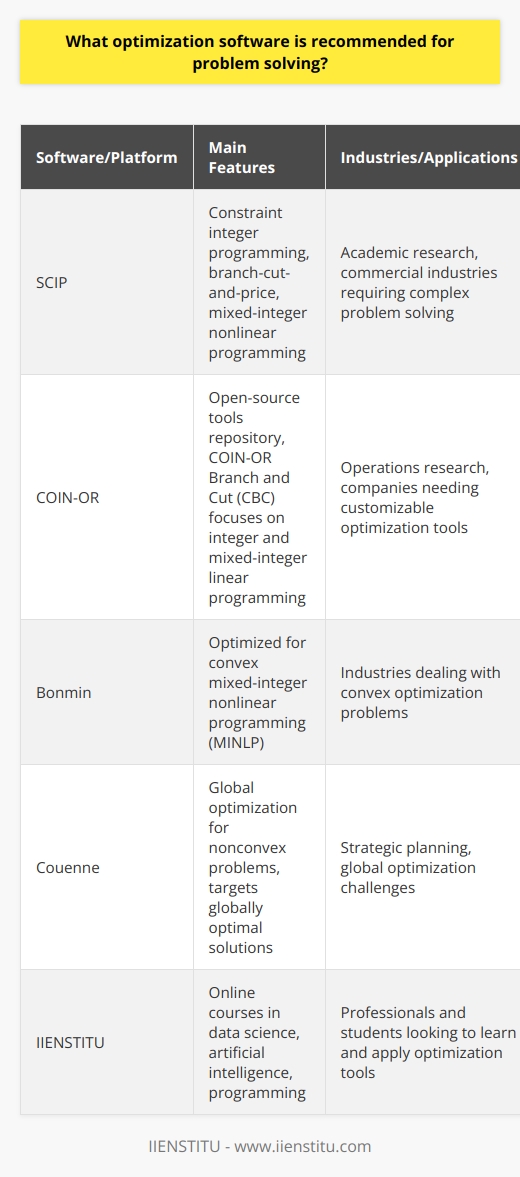
Optimization software is an indispensable tool for decision-making and problem-solving across various industries, from logistics and finance to manufacturing and healthcare. These software solutions facilitate the identification of the most efficient, cost-effective, and viable options within a vast array of possibilities. Although there are several optimization tools available in the market, we will highlight a select few that have distinguished themselves through their robust features and wide applicability.Let us delve into the features and benefits of some notable optimization software tools that have proven effective in solving complex problems:1. SCIP (Solving Constraint Integer Programs) is a highly versatile open-source tool capable of solving a wide range of optimization problems. SCIP specializes in constraint integer programming, branch-cut-and-price, and mixed-integer nonlinear programming. It is known for its state-of-the-art performance and can be employed for both academic research and commercial use. Its flexibility and power make it a preferred choice for researchers and professionals seeking to model and solve uniquely challenging problems.2. COIN-OR (Computational Infrastructure for Operations Research) comprises a repository of open-source software tools for operations research professionals. Within this collection, the CBC (COIN-OR Branch and Cut) solver is a notable example effective for integer and mixed-integer linear programming. These open-source tools are particularly valuable for both educational purposes and for companies that require customization to fit their specific optimization needs without the hefty cost often associated with commercial software.3. MINLP (Mixed-Integer Nonlinear Programming) Solvers such as Bonmin and Couenne are designed to tackle nonconvex, mixed-integer nonlinear problems. Bonmin is well-suited for convex MINLP, while Couenne aims at global optimization of nonconvex problems, providing solutions that are proven to be globally optimal. These solvers are part of the COIN-OR initiative and offer flexibility and effectiveness when dealing with nonlinearity in optimization problems.4. For those seeking online learning opportunities to further enhance their problem-solving skills using various tools, IIENSTITU offers a bevy of courses on data science, artificial intelligence, and programming. Courses like these provide learners with the theoretical and practical knowledge to leverage optimization software in real-world scenarios effectively. Education platforms like IIENSTITU emphasize the importance of continuous learning to stay ahead in fast-evolving technological domains.In essence, selecting the right optimization software is contingent upon the specific nature of the problem you are trying to solve. Tools such as SCIP, COIN-OR's CBC, Bonmin, and Couenne offer powerful capabilities for handling a wide range of optimization challenges. For those interested in expanding their knowledge base and learning how to apply these tools skillfully, educational resources like the ones provided by IIENSTITU are invaluable.Given the complexity of optimization problems and the myriad solutions available, combining theoretical knowledge with practical tool expertise is the key to deriving optimal solutions. Whether for logistics optimization, financial modeling, or strategic planning, problem solvers can leverage these high-quality software solutions to drive decision-making and innovation.
How do you develop math problem-solving skills?

Understanding Math Concepts

To develop math problem-solving skills, it is essential to first understand the underlying mathematical concepts. This involves studying and grasping essential principles, such as basic operations, factors, and multiples, as well as advanced theories like geometry, calculus, and algebra. A strong foundation in these concepts paves the way for effective problem-solving.

Engaging in Regular Practice

Regular practice is vital for honing math problem-solving skills. Setting aside dedicated time to complete math exercises on a daily basis enables gradual improvement and fosters long-term retention of mathematical concepts. The consistent practice also helps in identifying areas that require further improvement or clarification, providing opportunities for targeted learning.

Applying Different Strategies

Employing a variety of problem-solving strategies enhances one's ability to tackle diverse math problems. Strategies such as drawing diagrams, using trial and error, identifying patterns and employing logical reasoning aid in navigating complex problems. Experimenting with different approaches enables the discovery of preferred and efficient problem-solving methods.

Working through Examples

Working through solved examples is an effective way to develop math problem-solving skills. Doing so not only demonstrates the application of the concepts but also exposes different strategies for solving problems. Examining worked examples closely helps in identifying key steps and mistakes to avoid, thus enhancing one's problem-solving capability.

Collaborating with Peers

Collaborating with peers and engaging in group study sessions provide opportunities to learn from others, exchange problem-solving strategies, and receive valuable feedback. Discussing difficult problems with peers fosters critical thinking and helps in viewing problems from diverse perspectives, leading to better problem-solving skills.

Seeking Help from Teachers and Mentors

When encountering difficulties in solving math problems, seeking guidance from teachers or mentors is crucial. These experienced individuals can offer invaluable assistance and help in identifying misconceptions or gaps in knowledge. Their explanations and clarifications contribute significantly to the development of robust math problem-solving skills.

In conclusion, developing math problem-solving skills requires a clear understanding of mathematical concepts, regular practice, the employment of diverse strategies, analysis of solved examples, collaboration with peers, and guidance from experienced mentors. By incorporating these elements into one's study routine, one can continually enhance their math problem-solving abilities and excel in the subject.
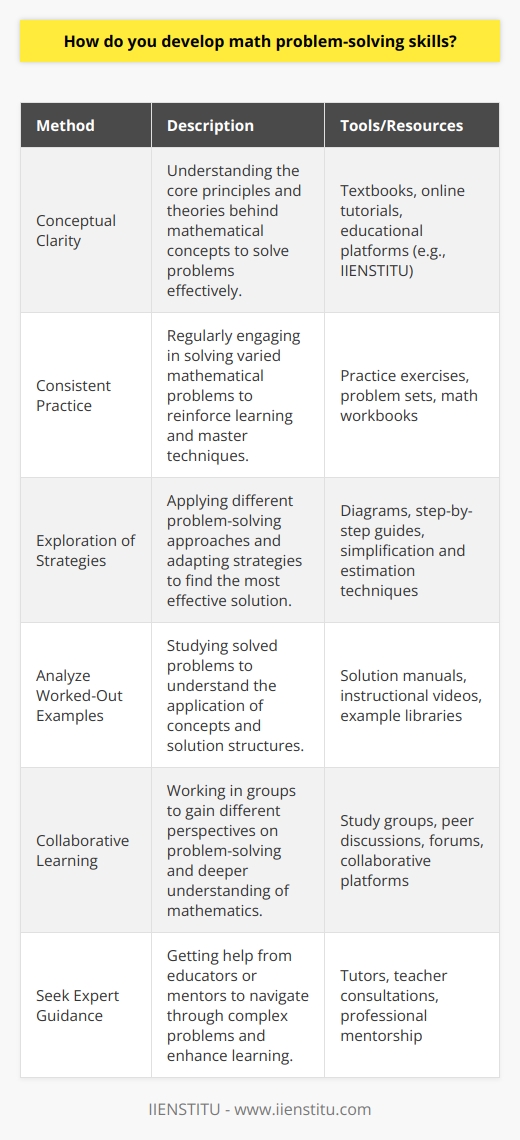
Developing math problem-solving skills is critical for academic success and practical applications in everyday life. Here's a structured approach to enhance these skills:1. Start with Conceptual Clarity:Solving math problems efficiently begins with a deep understanding of concepts. Learn the underlying theories and principles, from the four basic arithmetic operations (addition, subtraction, multiplication, and division) to more complex areas such as algebraic expressions, geometric theorems, calculus integrals, and statistical models. Use resources like textbooks, online tutorials, and educational platforms like IIENSTITU to build a strong conceptual base.2. Embrace Consistent Practice:Mathematics is not a spectator sport; regular engagement is key. Set aside time each day to practice mathematical problems, starting from simpler exercises and progressing to more complex challenges. This disciplined approach, much like training for a sport or a musical instrument, reinforces learning and aids in mastering problem-solving techniques over time.3. Explore Various Strategies:Problem-solving is often about finding the right approach. Experiment with different strategies—the visual representation of problems with diagrams, the logical progression of problem-solving steps, the simplification of complex issues through estimation, and the systemization of data for clarity. Switching strategies when one doesn't work is part of the learning process, helping to build flexibility in thinking.4. Analyze Worked-Out Examples:Studying examples that have already been solved is incredibly useful for understanding the application of math concepts to real-world problems. Pay attention to how the solution is structured, how each step logically follows from the last, and the methods used to arrive at the answer. This examination provides insight into solving similar problems and helps you avoid common errors.5. Collaborate to Learn More:Mathematics can often be more effectively understood in a collaborative environment. Study groups offer the chance to tackle problems together, learning from peers who might have different perspectives or methods. Such interactions promote a deeper understanding of the subject matter and can reveal new ways to think about and solve problems.6. Seek Expert Guidance:Never hesitate to ask for help when faced with challenging math problems. Educators and mentors can provide explanations that clear up confusion, offer shortcuts for problem-solving, and highlight areas that need extra attention. Their guidance can be the key to overcoming obstacles and making significant advancements in your problem-solving abilities.In essence, enhancing your math problem-solving skills is an ongoing process that combines comprehension, practice, strategy exploration, example analysis, collaboration, and mentorship. By dedicating focused time and effort to this multifaceted approach, you can develop a strong proficiency in mathematics that will serve you well in both academic pursuits and in navigating the complexities of the real world.
What are the six steps you need to follow when solving a statistical problem?

Defining the Problem

The first step in solving a statistical problem is to define the problem clearly. This involves identifying the research question, specifying the population of interest, and determining the purpose of the analysis.

Selecting the Appropriate Method

Once the problem is defined, the next step is to choose an appropriate statistical method to analyze the data. This choice depends on the type of data, research question, and the purpose of the analysis. It is important to ensure that the selected method is suitable for the problem to obtain valid and reliable results.

Collecting Data

Data collection is a critical step in the process, as the quality of the collected data directly impacts the accuracy and validity of the analysis. There are various methods to collect data, such as surveys, experiments, observational studies, and secondary sources. The chosen method should align with the research question and the population of interest to ensure that the data is representative and relevant to the problem.

Organizing and Cleaning Data

After collecting the data, the next step is to organize and clean the data for analysis. This involves checking for errors and inconsistencies, assessing missing values, and ensuring that the data is in a format suitable for the chosen statistical method. Proper organization and cleaning of the data help to prevent errors in analysis and improve the reliability of the results.

Analyzing Data

Once the data is organized and cleaned, the next step is to analyze it using the chosen statistical method. This involves performing calculations, conducting hypothesis tests, and estimating parameters or relationships based on the data. The process of data analysis aims to answer the research question and provide insights into the problem under investigation.

Interpreting and Presenting Results

The final step in solving a statistical problem is interpreting and presenting the results of the analysis. This requires evaluating the significance of the results, drawing conclusions, and explaining the findings in the context of the problem. Presenting the results in a clear and concise manner allows others to understand the implications of the research and how it contributes to the broader field of study.
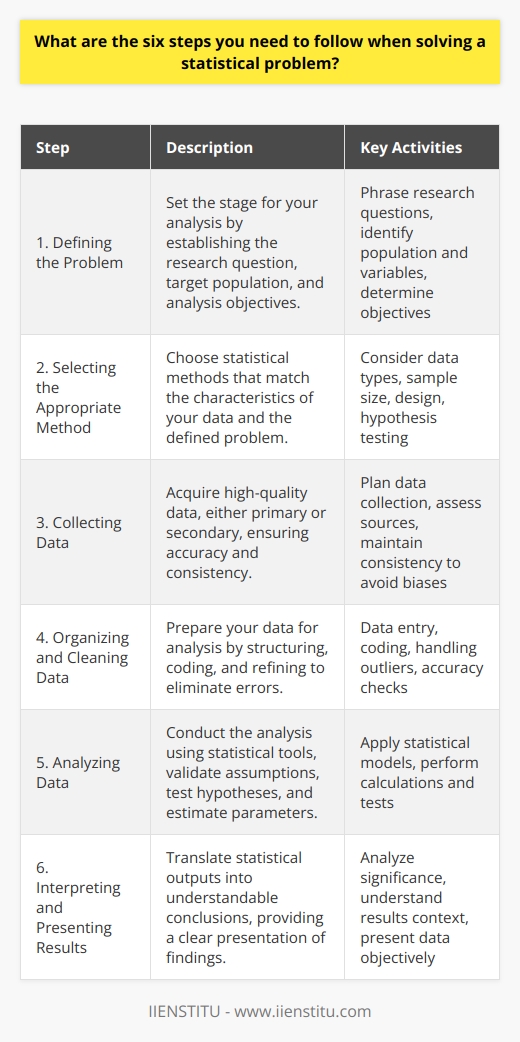
When solving a statistical problem, the approach you take can significantly influence the outcomes and their usefulness in addressing your research questions. Here are six methodical steps to ensure that your statistical analysis is robust and effective:1. **Defining the Problem:**   Before you plunge into the data, it’s imperative to frame the problem you're trying to solve. This involves precisely phrasing your research question(s) and understanding the scope and limitations of your investigation. This step sets the direction for everything that follows and involves identifying the target population, specifying the variables of interest, and establishing the objectives of your analysis. Clarity at this stage is paramount as it guides the selection of methods and the type of data required.2. **Selecting the Appropriate Method:**   The statistical method selected should align with the nature of your data and the problem defined. This means considering whether you’re dealing with categorical or continuous variables, the sample size, the study design, and the hypothesis you’re testing. Selection of an appropriate method is crucial because it underlies the legitimacy of your analysis. For example, you would use a different statistical test for assessing the relationship between two variables than you would for comparing averages across groups.3. **Collecting Data:**   Robust analysis springs from high-quality data. The process of data collection must be meticulously planned to ensure the integrity of the data. Depending on the problem, you might collect primary data through surveys or experiments or obtain secondary data from existing sources. Regardless of the source, the data should be relevant, accurate, and collected in a consistent manner to avoid biases that could skew your analysis.4. **Organizing and Cleaning Data:**   With data in hand, the next task is to structure it in a way that facilitates analysis. This involves tasks like entering data into a spreadsheet or database, coding categorical variables, handling missing or outlier values, and checking for any inaccuracies or duplication. Data cleaning is a critical step as errors at this stage can drastically affect the statistical results and lead to false conclusions.5. **Analyzing Data:**   The core of the process lies in analyzing the data appropriately using statistical software or tools. At this stage, you apply statistical models, run calculations, and perform tests to extract meaningful patterns, trends, and insights from the data. It’s also at this juncture where you validate your initial assumptions, test hypotheses, and estimate parameters that help answer the research question posited in the first step.6. **Interpreting and Presenting Results:**   The climax of your statistical analysis is translating the numbers into comprehensible conclusions. This step involves digesting the output from the analysis, making sense of the statistical significance, and understanding what the results mean in the context of the original problem. The presentation of your findings, whether in graphical, tabular, or written form, should be clear, objective, and include an honest appraisal of the limitations of your study.Approaching statistical problems with this structured six-step process ensures a disciplined and methodical investigation. From initial problem definition through to the final interpretation, these steps guide the researcher in producing reliable and insightful outcomes contributing valuable knowledge to their field. Organisations such as IIENSTITU provide educational resources that can deepen one's understanding of these steps and enhance their application in statistical analyses.
What are the problem solving skills in mathematics?

Defining Problem Solving Skills in Mathematics

Problem solving skills in mathematics are essential cognitive abilities that enable learners to effectively approach, analyze, and resolve various mathematical challenges. These skills encompass a systematic process that encompasses numerous strategies and techniques.

Strategies for Mathematical Problem Solving

Understanding the problem: A student must first comprehend the problem by breaking it down into smaller parts or sub-problems, and then, identify the important information needed to tackle it.

Devising a plan: Once the student understands the problem, they create a plan of action by selecting the appropriate strategies and mathematical tools, such as formulas or algorithms, to address it.

Executing the plan: The student applies the selected strategies and tools, solving the problem step-by-step while maintaining accuracy and precision in their calculations.

Evaluating the solution: The student checks the validity of their solution, comparing it with the original problem to ensure that it is logical and accurate.

Reflecting on the process: To improve their problem solving skills further, students review the entire process, identifying successful strategies and potential areas for improvement.

Enhancing Problem Solving Skills through Instruction

Mathematical problem solving skills can be honed through explicit instruction, modeling, and practice in the context of real-world scenarios. Teachers should encourage students to think critically, share their reasoning, and collaborate with peers to reach a deeper understanding of the problem-solving process. By fostering a positive and supportive learning environment, educators can build students' confidence in their abilities and promote the development of these crucial skills.
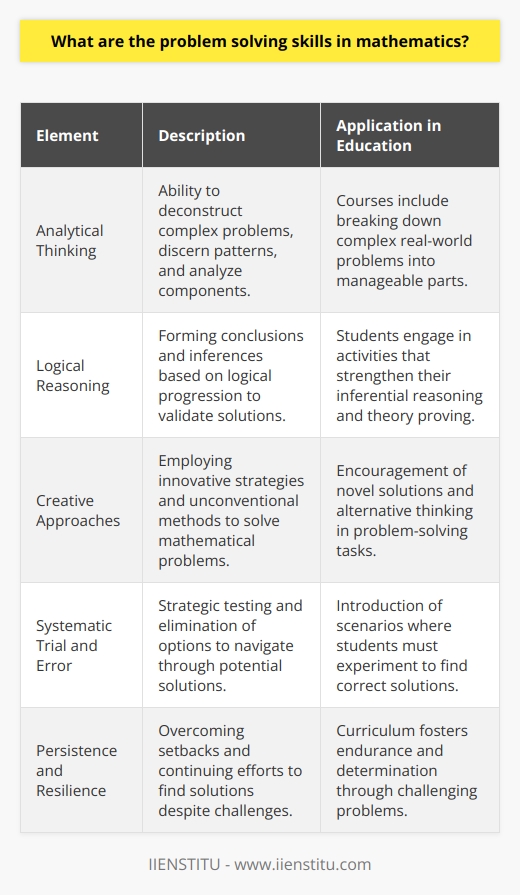
Problem solving skills in mathematics are vital in navigating the world of numbers, figures, and logical reasoning. These skills do not only revolve around the ability to perform calculations or follow algorithms; they also involve critical thinking, creativity, and the ability to connect various pieces of information to find a solution.The Core Elements of Mathematical Problem Solving Skills:Analytical Thinking: Critical to solving mathematical problems is the ability to break down complex problems into manageable parts and analyze each component. This kind of thinking requires discerning patterns, identifying relationships, and understanding the underlying principles that govern a mathematical concept.Logical Reasoning: Mathematics requires a logical approach. Problem solvers must draw conclusions from the information provided and make inferences based on logical progression. This process is crucial in proving theories, validating solutions, and avoiding fallacies that could lead to incorrect answers.Creative Approaches: Effective problem-solving often involves thinking outside the box. Creative thinking in mathematics might include finding new ways to approach a problem, simplifying equations, or employing less conventional methods to find a solution.Systematic Trial and Error: Sometimes, mathematical problem solving entails systematic experimentation. This method involves navigating through multiple potential solutions and identifying the correct one by eliminating the incorrect options through strategic testing.Persistence and Resilience: Problems are not always solved on the first try. Strong problem-solving skills include persistence in finding a solution and resilience to overcome frustration and setbacks, which are often part of the learning process.Incorporating Problem Solving in Mathematics Education:Educational institutions like IIENSTITU recognize the importance of integrating problem-solving skills into their curriculum. Tailored courses are designed to foster these abilities by providing students with complex, real-world problems that require more than rote memorization or the application of standard formulas.For example, students at IIENSTITU may encounter scenarios that require them to apply mathematical models to business forecasts, data analysis, or technological developments. By tackling such challenges, students learn to employ various problem-solving strategies and develop a robust set of skills that are applicable both within academic settings and in their professional lives.Instructors, likewise, are trained to guide students through the problem-solving process, providing encouragement and feedback that inspires an investigative mindset. They ask probing questions that prompt students to delve deeper into the subject matter and to view problems from multiple angles.Moreover, fostering a collaborative environment wherein students can exchange ideas, argue methodologies, and collectively work toward solutions serves to enrich their learning experience. This collaborative approach not only enhances students’ individual problem-solving skills but also prepares them for teamwork and communication in their future careers.Problem-solving skills in mathematics are, therefore, not simply about finding the right answer. They're about developing a toolkit of cognitive abilities, a mindset for inquiry, and a persistent approach to tackling mathematical issues. Through institutions like IIENSTITU, which promote such comprehensive education, students can master these indispensable skills and apply them effectively in numerous contexts.
How do you demonstrate problem-solving skills in an interview?

Demonstrating Problem-Solving Skills in an Interview

Understanding Interview Expectations

In an interview setting, it is essential to grasp the expectations of potential employers. Demonstrating problem-solving skills involves showcasing the ability to approach difficult situations, logically assess available information, and deliver effective resolutions. Interviewers often present hypothetical or real-life scenarios to evaluate how well an applicant can handle challenges.

Breaking Down Problems

How a candidate dissects a problem is crucial in forming a viable solution. Structured thinking, breaking down problems into smaller, more manageable parts, and identifying the root cause can showcase organized and effective thought processes. Employing this approach demonstrates analytical and critical thinking abilities, which are highly valued by many industries.

Applying Relevant Experience

Leveraging personal experiences relevant to the specific problem can prove useful in highlighting past successes in overcoming challenges. When discussing past experiences, it is important to focus on the actions taken, challenges faced, and results achieved. Specific examples from previous work or academic experiences can provide tangible evidence of the candidate's problem-solving capabilities.

Employing Creative Approaches

Creativity is a vital element in problem-solving. Demonstrating original and innovative ideas in response to potential obstacles can set a candidate apart from the competition. Engaging the interviewer with inventive thought processes can be as simple as reframing their question or proposing alternative solutions they may not have considered.

Adaptability and Flexibility

When tackling complex issues, sometimes the initial solution is not the most effective. It is essential to demonstrate adaptability and willingness to change strategies when necessary. Communicating flexibility and openness to different approaches can convince interviewers of a candidate's ability to problem-solve in varying situations.

Collaboration and Communication

Problem-solving often requires collaboration with others. An essential component of this skill is the ability to communicate ideas and facilitate teamwork. Collaborative examples from past experiences or suggestions of how to work with others to resolve potential issues convey a candidate's ability to thrive within a team environment.

Preparing for Problem-Solving Questions

To excel in an interview, one should prepare beforehand for potential problem-solving questions. Identifying critical experiences, practicing articulating them succinctly, and exhibiting a willingness to learn from past challenges can demonstrate a candidate's readiness to tackle future obstacles.

In conclusion, effectively showcasing problem-solving skills in an interview involves understanding the expectations, employing structured and adaptable thought processes, communicating relevant experiences, and exhibiting creativity when addressing potential challenges. Preparation and confidence in one's abilities can be instrumental in securing a position that requires strong problem-solving skills.
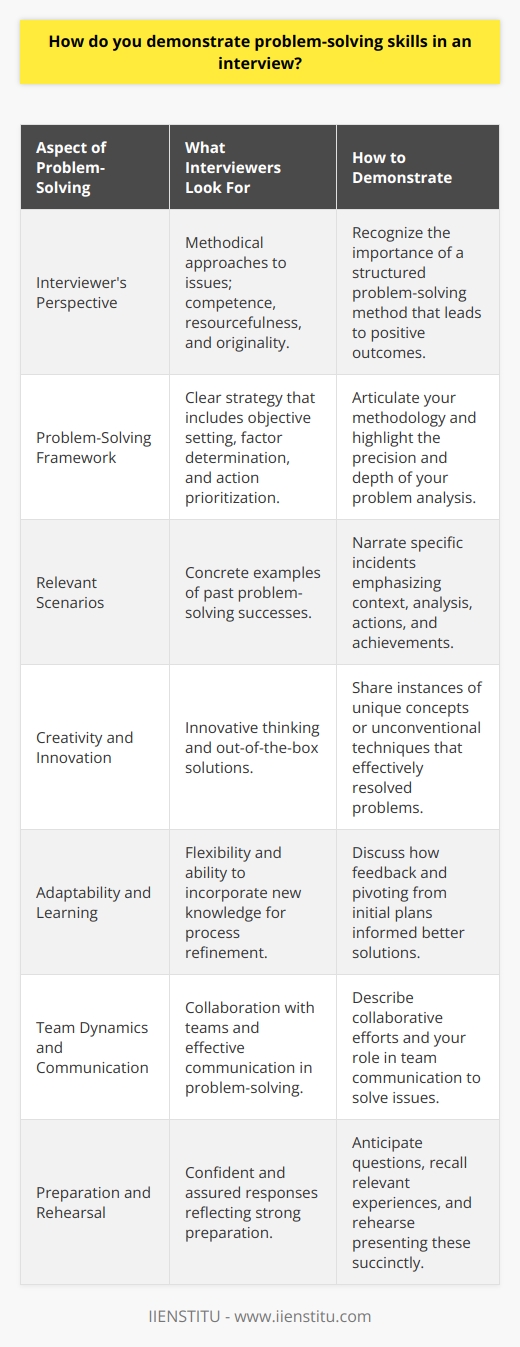
Demonstrating problem-solving skills in an interview can be a definitive factor in distinguishing oneself as a potential asset to any team. Here's how to effectively exhibit these abilities during the interview process:**Understand the Interviewer's Perspective**Interviewers seek individuals who can methodically confront issues and initiate positive outcomes. They may explore not only the end result but also the reasoning process that led there. It is important to recognize that they are looking for competence, resourcefulness, and originality in candidates' methods of addressing challenges.**Articulate a Problem-Solving Framework**To impress the interview panel, articulate your approach to complex problems. Outline your strategy for analyzing the situation, which could involve setting clear objectives, determining key factors, and prioritizing actions. Highlight how you control for variables to stay focused on the core issue, a method that emphasizes both precision and depth in your problem-solving style.**Showcase Relevant Scenarios**Interview responses become compelling when they are rooted in real-life situations. When asked to illustrate your problem-solving skills, narrate specific incidents where you've successfully navigated difficult situations. Discuss the context, your analysis, the action steps you took, and the resultant accomplishments. This narrative style underscores not only your capability but also your experience in handling practical difficulties.**Highlight Creativity and Innovation**Problem-solving is synonymous with innovative thinking. In situations where conventional strategies fail, your ability to think out-of-the-box becomes invaluable. Share instances where you introduced novel concepts or adopted unorthodox techniques that were effective in resolving issues. Such examples reveal your willingness to pioneer new solutions and adapt to changing circumstances.**Adaptability and Lessons Learned**A problem-solving discussion should reflect your adaptive nature and your commitment to continuous learning. Talk about times you incorporated feedback or pivoted from an initial plan. Mention how you assimilated new information to refine processes and reach better solutions. This openness to learning and growth speaks volumes to interviewers about your long-term value to the organization.**Team Dynamics and Communication**Highlighting your collaborative skills is crucial. Problem-solving rarely occurs in isolation; therefore, articulate how you've worked effectively with teams to surmount obstacles. Detail how your communication skills were integral in rallying team members and managing stakeholders to implement solutions. This points to your leadership potential and your ability to contribute to a positive organizational culture.**Prepare and Rehearse**Preparation is key. Anticipate potential problem-solving questions, recollect past experiences that best illustrate your abilities, and practice articulating these scenarios succinctly. A well-prepared response sounds confident and assured, reinforcing the interviewer's perception of your problem-solving acumen.In summary, to effectively demonstrate problem-solving skills in an interview, offer a clear breakdown of your problem-solving process, provide engaging and relevant examples, emphasize creativity and adaptability, underscore collaborative efforts, and impeccably prepare for the interaction. This comprehensive strategy will not only reveal your capability to address complex challenges but also solidify your standing as a strong contender for the role.
What are some examples of problem-solving skills?

Analytical Thinking

One example of problem-solving skills is analytical thinking, which involves breaking down complex issues into manageable components. This allows individuals to identify the root cause of a problem and devise potential solutions.

Critical Thinking

Critical thinking, another problem-solving skill, involves objectively evaluating information to determine whether it is credible and relevant. This process allows individuals to make informed decisions and consider multiple perspectives before selecting a solution.

Creative Thinking

Creative thinking is essential for developing innovative solutions to problems. This skill encourages individuals to think outside the box and consider unorthodox approaches that may not have been previously considered.

Decision Making

Effective problem-solving also depends on sound decision-making abilities. This skill requires weighing the pros and cons of various solutions and selecting the best course of action based on the available information.

Research Skills

Strong research skills play a crucial role in the problem-solving process. Individuals must be able to gather relevant information from various sources, evaluate its credibility, and utilize it to better understand a given problem and develop potential solutions.

Collaboration and Communication

Working with others is often necessary for solving complex problems. This requires strong collaboration and communication skills, enabling individuals to effectively contribute their ideas, listen to various perspectives, and adapt their approach based on the group's input.

Adaptability and Flexibility

Problem-solving also demands adaptability and flexibility, as circumstances often change, requiring individuals to alter their strategies. These skills involve modifying one's approach when new information emerges or when unforeseen obstacles arise.

Emotional Intelligence

Emotional intelligence, or the ability to recognize and manage one's emotions and those of others, can significantly impact problem-solving success. This skill enables individuals to approach problems with a clear, focused mindset and navigate challenging situations with resilience.

Learning from Failure

Lastly, effective problem solvers must possess the ability to learn from failure. They should be able to acknowledge when an approach did not work, analyze the reasons behind it, and modify their strategy accordingly moving forward.
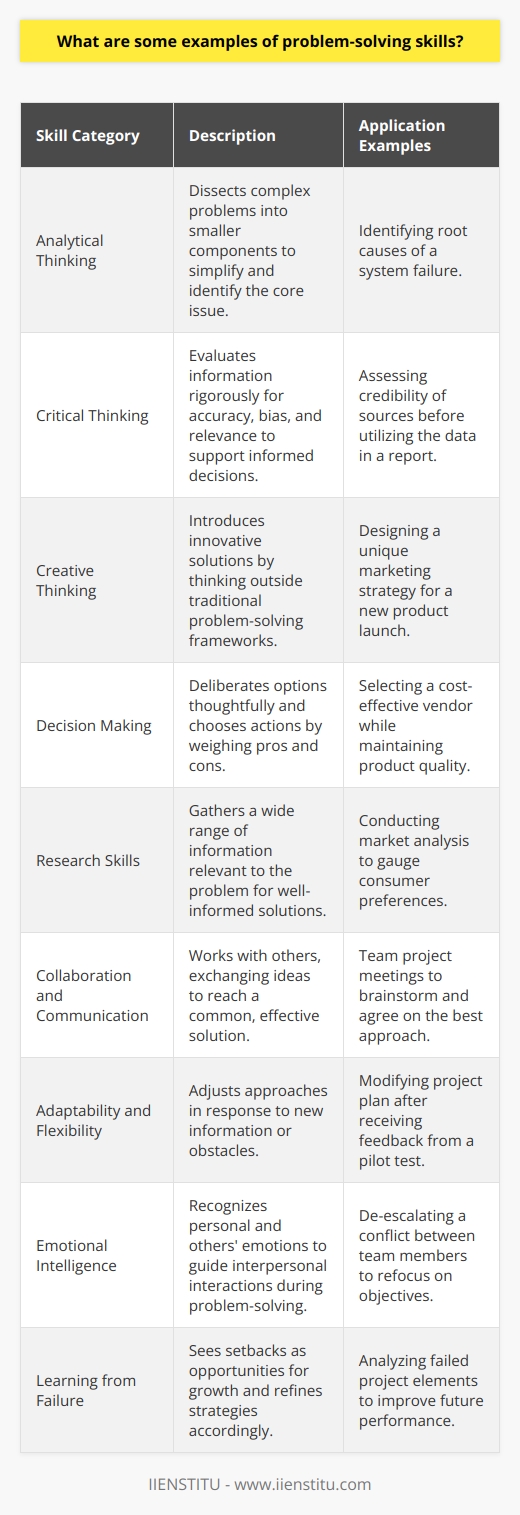
Problem-solving skills encompass a range of cognitive and social abilities that enable individuals to handle and resolve challenges effectively. Beyond analytical, critical, and creative thinking skills, decision-making, and research proficiency, people often need to harness collaboration, communication, adaptability, emotional intelligence, and an ability to learn from failure to navigate complex problems successfully.**Analytical Thinking:** Analytical thinkers dissect complex problems into smaller, more digestible parts. This methodical breakdown helps in pinpointing the exact issue at hand, simplifying the labyrinth of potential contributing factors, and illuminating pathways to solutions.**Critical Thinking:** A critical thinker scrutinizes information rigorously. They assess sources for accuracy, bias, and relevancy, thereby ensuring that any decision made or solution crafted is founded on dependable insights. Critical thinking is also about questioning assumptions and considering the implications of potential solutions.**Creative Thinking:** Approaching a challenge with a fresh perspective is the hallmark of creative thinking. Creative thinkers propose innovative and sometimes unconventional solutions that may bypass traditional routes, thereby finding effective yet less obvious resolutions to difficult problems.**Decision Making:** Decision-making involves conscientious deliberation of the available options. Problem solvers with keen decision-making abilities can balance the advantages and disadvantages of different approaches and select the most beneficial action while considering the potential outcomes for all stakeholders.**Research Skills:** Research abilities enable individuals to amass a broad spectrum of information pertinent to the problem. Whether they're culling data from digital databases, conducting interviews, or mining case studies for insights, adept researchers enrich the problem-solving process with valuable information that can be leveraged to construct well-informed solutions.**Collaboration and Communication:** No problem exists in a vacuum, and often the best solutions arise from a collective effort. Teamwork necessitates individuals to communicate clearly, listen actively, and integrate diverse perspectives. Efficient collaboration hinges on the exchange of ideas and building consensus around the most viable solutions.**Adaptability and Flexibility:** The capacity to pivot in response to changing situations is indispensable during the problem-solving process. Adaptive problem solvers are open to reshaping their approach when new insights come to light or when initial plans encounter obstacles, ensuring continual progress towards resolution.**Emotional Intelligence:** The human dimension of problem-solving often makes emotional intelligence a critical skill. Recognizing one’s emotions and managing interpersonal dynamics during problem-solving processes can help in maintaining a calm, composed atmosphere conducive to idea generation and conflict resolution.**Learning from Failure:** Finally, the willingness to view setbacks as learning opportunities is vital. When a chosen solution fails to yield the desired outcome, learning-oriented problem solvers are quick to reflect, discern the flaws in their approach, and iteratively refine their strategies.In the broader context of education and professional development, institutions like IIENSTITU can provide valuable resources and training to enhance these problem-solving skills, preparing individuals to confront real-world challenges with confidence and expertise. By fostering these competencies, people are better positioned to tackle problems effectively, whether in professional settings, academia, or daily life.
How can logic and reasoning be used to improve mathematical problem-solving abilities?

Developing Logical Thinking Skills

Logic and reasoning play a critical role in enhancing mathematical problem-solving abilities. The foundation of logic consists of understanding how to structure arguments, identify patterns, and form correct conclusions based on premises.

Practicing Math Puzzles

By engaging with mathematical puzzles, one improves their ability to apply logical thinking. These puzzles range from Sudoku to logic grid puzzles, which generally require the solver to use deductive reasoning to identify a solution. This practice hones our skills in pattern recognition and logical deduction, which then translate to improved problem-solving abilities in other mathematical domains.

Using Syllogisms in Mathematics

Syllogisms are logic exercises that help in understanding the relationships between statements. They involve a major premise, a minor premise, and a conclusion. For example, if 'all circles are round' (major premise) and 'shape A is a circle' (minor premise), you can deduce that 'shape A is round' (conclusion). This concept can be extended to abstract mathematics by analyzing patterns and relationships between numbers and variables.

Evaluating Counterexamples

Assessing counterexamples is another useful method for solidifying logical concepts in mathematics. A counterexample is an instance where a statement's premise is true, but the conclusion is false. For example, the statement 'all prime numbers are odd' is disproven by the counterexample of the number 2, which is both prime and even. By working through counterexamples, we strengthen our logical reasoning and become more adept at identifying incorrect premises or conclusions.

Applying Logic to Real-life Scenarios

Applying logical reasoning beyond the classroom is essential in developing mathematical problem-solving abilities. For example, consider planning a travel itinerary with specific constraints, such as budget or time. This scenario would require one to efficiently allocate resources and make decisions based on logical reasoning. Incorporating these skills into daily life can improve mathematical problem-solving abilities by reinforcing logical thinking habits.

In conclusion, enhancing logical thinking skills through puzzles, syllogisms, counterexamples, and applying them to real-life scenarios can lead to improvements in mathematical problem-solving abilities. By embracing these strategies, individuals cultivate essential reasoning skills that contribute significantly to achieving success in mathematics and beyond.
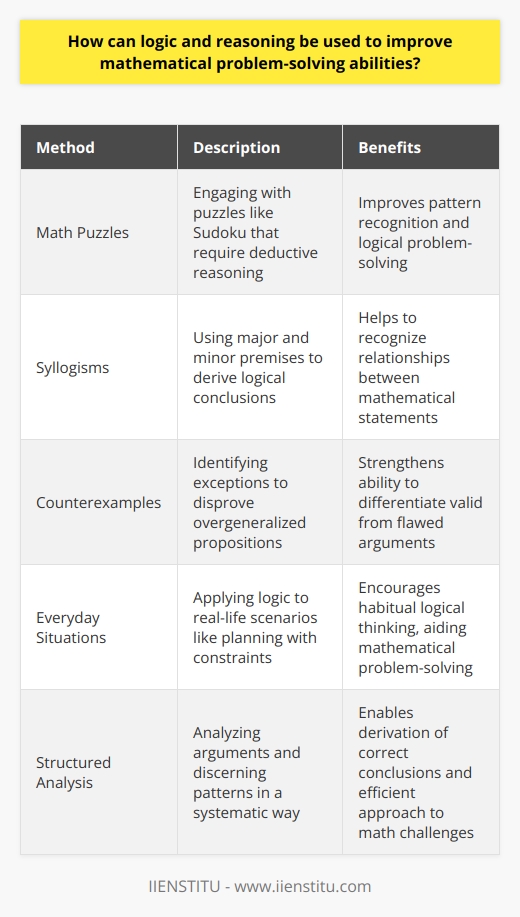
Developing Logical Thinking SkillsEnhancing mathematical problem-solving abilities is critically intertwined with the mastery of logic and reasoning. The core of logic is the structured analysis of arguments, discerning of patterns, and derivation of correct conclusions from given premises. Logical thinking is a pillar in the realm of mathematics, facilitating a clearer understanding and more efficient approach to mathematical challenges.Improving Pattern Recognition through Math PuzzlesMathematical puzzles are a delightful and effective way to sharpen logical thinking skills. They compel us to apply logical reasoning in unraveling the puzzles' intricacies. Engaging regularly with puzzles such as Sudoku and various logic grid problems requires deductive reasoning—this is essential for identifying solutions. Exercises in pattern recognition gained through puzzles directly bolster our mathematical problem-solving capabilities.Harnessing Syllogisms to Structure Mathematical ThoughtSyllogisms serve as a helpful tool in cultivating proficiency in recognizing relationships between different mathematical statements. A typical syllogism consists of a major premise, a minor premise, and a conclusion that logically follows. In mathematics, this method of reason can apply to discern patterns and relationships between numerical expressions and variables, thereby enhancing problem-solving efficiency.Evaluating Counterexamples to Refine UnderstandingIn mathematics, evaluating counterexamples is a valuable exercise for affirming or challenging mathematical propositions. A counterexample shows that a general statement does not hold in all cases—such as the assertion all prime numbers are odd, which is invalidated by the prime number 2. By considering counterexamples, one reinforces their capacity for logical reasoning, becoming more proficient in distinguishing valid arguments from flawed ones.Integrating Logic with Everyday SituationsApplication of logical thinking to everyday scenarios is an excellent approach to solidify mathematical problem-solving acumen. Consider, for instance, the planning of a travel schedule within particular constraints such as budget or time. This task demands the allocation of resources and decision-making grounded on logical reasoning. Regularly engaging in such activities bolsters the habit of logical thinking, with positive repercussions for mathematical problem-solving skills.In sum, the reinforcement of logical thinking through puzzles, syllogisms, and real-life applications is crucial for enhancing mathematical problem-solving. Logic and reasoning are not merely academic pursuits but are tools that, when wielded with proficiency, can lead to tremendous growth in mathematics and diverse areas that require structured thought.
What are the key components of effective mathematical problem-solving strategies?

Understanding the Problem

The first component of efficient problem-solving in mathematics is understanding the problem. This phase involves interpreting the problem and identifying what the problem asks.

Devising a Plan

Once learners understand a problem, they should devise a plan of action. The plan can derive from recalling similar problems, rephrasing the problem, breaking the task into smaller manageable parts, or creating diagrams.

Implementing the Plan

The next stage is the execution of the plan. It involves applying mathematical knowledge and techniques to problem-solving. Informative note-taking, systematic computations, and use of suitable algorithms occur in this stage.

Checking the Answer

Lastly, checking the answer is a vital step that confirms the rightness of the final result. Reviewing the calculations and reasoning or checking the answer against the problem statement helps achieve accurate results.

Reflection on the Problem-solving Process

Reflection forms an integral part of mathematical problem-solving. Through reflection, students evaluate the effectiveness of their strategies, which promotes learning from mistakes and successes.

In conclusion, effective mathematical problem-solving strategies consist of understanding the problem, devising a plan, implementing the plan, checking the answer, and reflection. These key components ensure a systemic, structured and analytical approach to tackling mathematical problems.
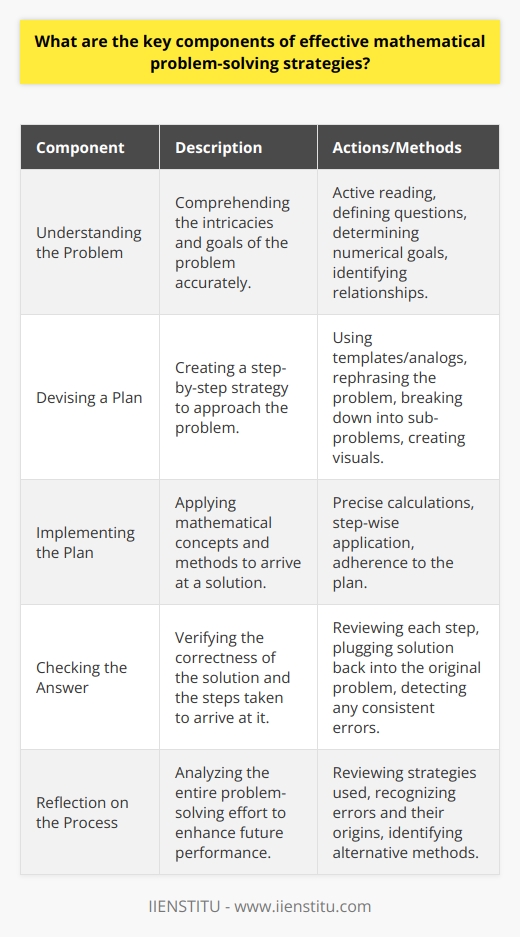
Effective mathematical problem-solving is a cornerstone of success in a variety of academic and professional fields. Mastery of this skill enables individuals to approach complex challenges logically and systematically. To foster such capabilities, here are the key components of effective mathematical problem-solving strategies.**Understanding the Problem**The foundational aspect of problem-solving in mathematics is accurately comprehending the problem at hand. This requires active reading to grasp the context and nuances. Questions need to be defined clearly, along with determining numerical goals or finding the relationships between given data points. By fully understanding what is required, one avoids misdirection in subsequent steps.**Devising a Plan**Planning is an art in mathematical problem-solving. This stage transforms the abstractions of the problem into a concrete strategy, which can involve several methods:- Drawing from previously solved similar problems can provide a template or analogy to tackle the new challenge.- Rephrasing the problem into simpler terms or a more familiar context can make it more manageable.- Breaking down the problem into sub-problems can make complex tasks seem less daunting and clarify what immediate steps to take.- Creating visuals like diagrams or tables can help one to organize thoughts and see patterns or relationships more clearly.**Implementing the Plan**Executing the planned approach is where one applies mathematical concepts and tools to solve the problem. During this phase, attention to detail is critical. Precise calculations and logical, step-by-step application of mathematical methods are required. It's essential to conform to the structure of the plan while remaining flexible enough to make mid-course corrections if an unexpected hitch arises.**Checking the Answer**Verification is a critical component that is often overlooked. Once a solution is reached, it is imperative to go over the work and ensure that every step is correct and that the solution logically follows from the given information. It's helpful to plug the solution back into the original problem when possible, to ensure that it truly works. Consistent errors can often be detected at this stage, preventing them from becoming habitual.**Reflection on the Problem-solving Process**Post-solution reflection is a powerful learning tool. At this point, the solver should review the process to understand what strategies worked well and which did not. Identifying alternate methods, recognizing the origins of any errors, and cataloging successful tactics for future use are all part of this reflective process. This self-evaluation fosters improvement, making each subsequent problem-solving effort more efficient and successful.In essence, mathematical problem-solving strategies that encompass understanding the problem, devising a plan, implementing the plan, checking the answer, and reflecting on the process, offer a robust framework for successfully navigating mathematical challenges. These components can be significantly enhanced through educational platforms, of which IIENSTITU stands as a keen advocate, promoting structured learning and problem-solving skills across various disciplines including mathematics.
How does the development of problem-solving skills impact one's success in various academic disciplines?

Role of Problem-Solving Skills in Academic Success

Problem-solving skills play a pivotal role in one's academic success. They are invaluable tools in virtually every field of study. Regardless of the discipline, scholars frequently encounter complex situations that require analytical thinking.

Impact on Math and Science Disciplines

In disciplines such as Math and Science, profound problem-solving skills enable students to deconstruct complex tasks, further promoting understanding. This is crucial in these fields because understanding the problem is the first step towards finding the solution.

Impact on Humanities and Social Sciences

In Humanities and Social Sciences, problem-solving skills help students analyze different viewpoints to make reasoned arguments. These disciplines often demand a subtle form of problem-solving skills, including dissecting arguments, assessing evidence, and crafting persuasive positions.

Facilitating Critical Thinking

Critical thinking often serves as a prerequisite for effective problem-solving. It requires the student to evaluate data critically, process information in a logical way, and make decisions based on evidence, essential across all academic disciplines.

Promoting Creativity

Problem-solving also encourages creativity. For instance, problem-solving in subjects such as arts or literature often demands novel thinking. This fuels creativity, which can translate to academic success in such disciplines.

Incorporating Teamwork

In disciplines that involve group work, problem-solving skills can foster better teamwork. The ability to analyze and resolve group conflicts or problems contributes to a productive work environment and leads to higher-quality group performance.

In conclusion, the development of problem-solving skills is an essential ingredient of academic success across various disciplines. Problem-solving fosters critical thinking, encourages creativity, and supports effective teamwork, all of which are significant contributors to academic achievement.
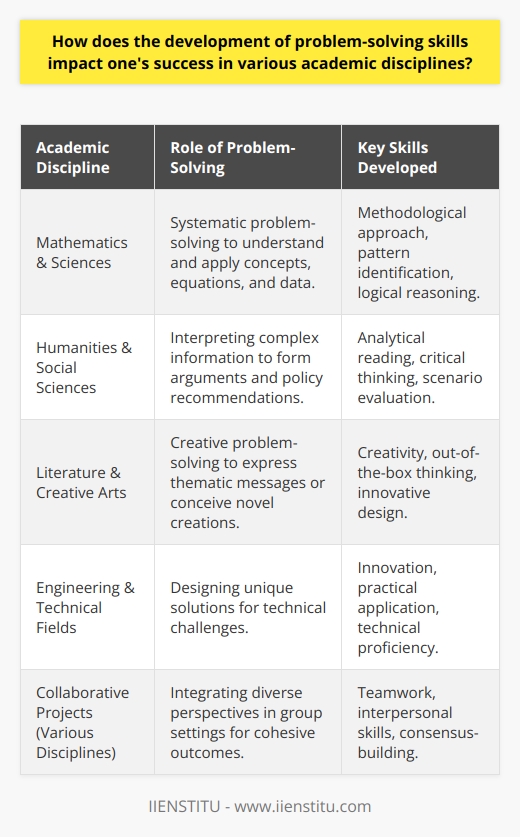
The acquisition and refinement of problem-solving skills are crucial for navigating the complexities of academic subjects and by extension, are a significant determinant of success in various academic disciplines. In mathematics and the sciences, problem-solving is the heart of the discipline. To grasp mathematical concepts or comprehend complex scientific theories, students must first decipher the problems at hand. Excelling in these areas is often hinged on the ability to parse through equations or experimental data, identify patterns or underlying principles, and construct viable solutions. Problem-solving in these fields is generally systematic and relies on a clear methodology – for example, the scientific method in science or the proof structure in mathematics.Within the humanities and social sciences, problem-solving assumes a different, though equally critical, role. In these disciplines, problems may not always be quantitative but are often issues of interpretation, ethics, policy, or human behavior. Students adept in problem-solving can sift through complex historical documents, philosophical discourses, or societal issues to formulate coherent, valid arguments or policy recommendations. Here, the emphasis is on analytical reading, critical thinking, scenario evaluation, and evidence-based conclusions.Critical thinking is integral to problem-solving. Whether deducing a theorem in mathematics or evaluating the sources of a historical event, students are called upon to dissect information critically, differentiate between correlation and causation, and draw informed conclusions. This form of thinking is universally valuable across academic disciplines and is often what distinguishes a proficient student from an outstanding one.Moreover, problem-solving can ignite a student's creative spark. In creative and performing arts, literature, and even in certain areas of technical fields, novel solutions are lauded. For example, an art student may be required to create a piece that communicates a specific thematic message or an engineering student might design a unique solution to a technical challenge. Both scenarios demand high creativity, which problem-solving skills can greatly enhance by urging students to think outside the box and develop innovative approaches.Collaborative efforts are also often integral to academic disciplines, from lab work in science to group assignments in business studies. Problem-solving is indispensable in these settings as it equips students with the abilities to harmoniously blend diverse viewpoints, navigate interpersonal dynamics, and effectively contribute to collective objectives.Incorporating problem-solving skills into an academic framework has significant benefits. Apart from fostering intellectual growth, these skills can build resilience and adaptability, empowering students to tackle unforeseen challenges within and beyond their formal education.In essence, well-honed problem-solving abilities can propel students to new heights of academic achievement. They serve as the nexus of critical thinking, creativity, and collaboration, providing a foundation for innovative solutions in any context. Problem-solving is not merely a skill but a versatile tool that enables students to unlock their full potential across a spectrum of academic pursuits.
In what ways can the art of problem solving approach be applied to real-world situations outside of mathematics?

Problem-Solving Application in Career Fields

The art of problem-solving indeed extends beyond mathematics and is applicable in various real-world situations. For instance, in the field of business, executives often use problem-solving strategies to tackle complex project management tasks, devise marketing strategies, or improve operational efficiency.

Approach in Negotiation Scenarios

Negotiations also hinge on problem-solving approaches, specifically when creating win-win situations. As parties aim for mutually beneficial outcomes, strategic problem solving allows negotiators to comprehend the needs, preferences and limitations of all involved effectively.

Relevance in Personal Life

The approach also proves invaluable for handling personal challenges and making crucial life decisions. It encourages individuals to evaluate different aspects of a problem, consider various solutions, and make a decision that best suits their personal circumstances.

Usage in Public Policy

Lastly, problem-solving plays a critical role in shaping public policies. Policymakers need to identify societal issues, conceive possible solutions, and employ critical thinking skills to select the most effective strategies.

In essence, the art of problem-solving serves as a versatile tool usable in various life contexts, for career advancements, personal growth, and societal development. Therefore, mastering this skill forms an integral part of lifelong learning and success.
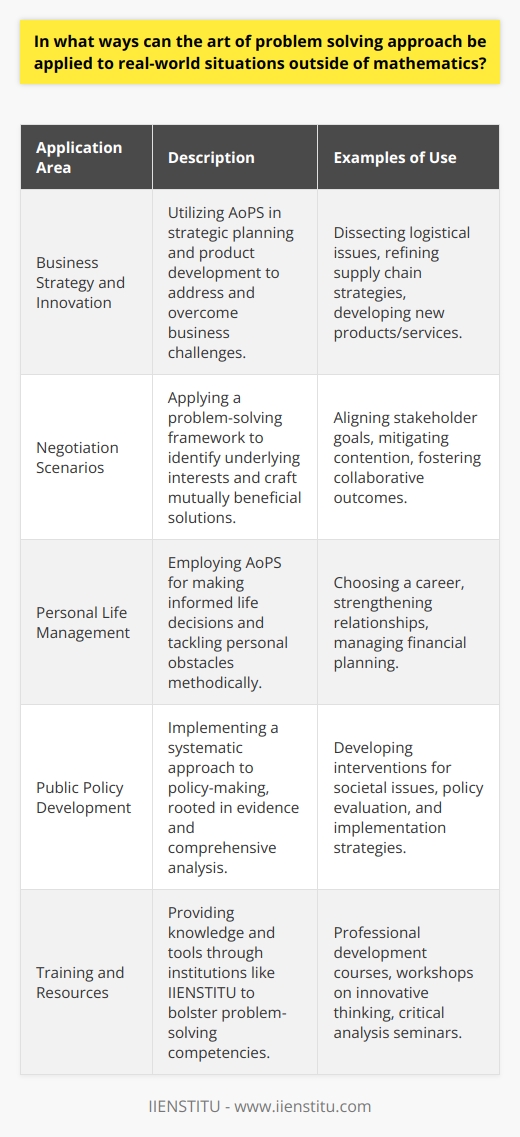

The Art of Problem Solving (AoPS) approach is not just bound by the parameters of mathematics; it is a potent framework that extends its reach into the fabric of real-world situations. Its versatility can be utilized in diverse career fields, from business and negotiation to personal life management and the development of public policies.**Career Fields: Strategy and Innovation**Within the realm of business, the AoPS approach is indispensable for strategic planning and innovation. Managers and entrepreneurs often engage in problem-solving sequences to dissect complex challenges, such as logistical hurdles, supply chain disruptions, or product development issues. They apply critical thinking to break down problems into manageable parts, hypothesize solutions, and iteratively test their assumptions to adapt and refine strategies. Moreover, the approach assists in identifying market gaps and in the cultivation of innovative products or services that cater to evolving consumer needs.**Approach in Negotiation Scenarios**Negotiations are intense situations where the problem-solving mindset shines brightly. Successful negotiators employ this approach to map out negotiation dynamics comprehensively. They seek to understand underlying interests rather than just positions, which facilitates crafting solutions that align with the core concerns and goals of all involved. By doing so, negotiations become less about contention and more about collaborative problem-solving, leading to solutions where all parties feel they benefit.**Relevance in Personal Life**On a more personal scale, the AoPS approach is critical when dealing with life's myriad decisions and obstacles. Whether it is choosing a career path, resolving conflicts in relationships, or managing financial hurdles, the methodology promotes a thoughtful appraisal of the issues at hand. It helps individuals to prioritize goals, objectively evaluate options, and develop a structured plan of action that is responsive to the complexity of personal circumstances.**Usage in Public Policy**In the realm of public policy, problem-solving is a foundational element. Policymakers are tasked with deciding on issues that impact communities and nations, where simple answers are seldom available. This requires a robust problem-solving framework to identify problems systematically, brainstorm potential interventions, and implement solutions that are rooted in evidence-based analysis. The AoPS approach ensures that policy decisions consider the multifaceted nature of societal issues and are subjected to a rigorous process of evaluation. In sum, the art of problem-solving is a universal key unlocking potential across multiple spectrums of life and work. Engaging with this approach fosters a proactive mindset, equipping individuals and professionals with the capacity to address, dissect, and overcome challenges that arise. It is this skill that underpins the pillar of successful adaptation and innovation in an ever-changing world. Consequent to this understanding, institutions like IIENSTITU provide valuable resources and training to hone these critical skills, recognizing their indispensable role in personal and professional development.

Related Articles

Developing Problem-Solving Skills: What Employers Want

Developing Problem-Solving Skills: What Employers Want

January 28, 2023
What are Problem Solving Skills?

What are Problem Solving Skills?

November 28, 2021
Unlocking Problem Solving Skills: Where Do Problems Come From?

Unlocking Problem Solving Skills: Where Do Problems Come From?

February 18, 2023
IIENSTITU LogoIIENSTITU

Professional online education platform to advance your career

Course CategoriesBlog CategoriesCorporate TrainingSupportUnsubscribePoliciesCertificate VerificationContactAbout InstitutePrivacy and Security PolicyDistance Sales ContractCancellation and Return TermsMembership Agreement
Follow Us:
figin

© 2012–2025 IIENSTITU - All rights reserved

IIENSTITU
IIENSTITU
CoursesInstructorsCertificateBlog
IIENSTITU
Login
Download CSV
Table with 10 rows and 3 columns
Calculus of VariationsA powerful tool used to calculate a function's minimum or maximum by taking derivatives of a function concerning a variable.Frequently used in engineering and physics to optimize processes.
SpreadsheetsAn essential tool for solving two-way tables which allows user to enter and manipulate the data to gain insights.Can be used to create graphs and plots of data.
Optimization SoftwareSoftware used to optimize functions by finding local maxima or minima of a complicated function.Can optimize a process to achieve a desired result in complicated situations.
ExcelA powerful platform for writing small programs, creating graphs and plots of data, and solving complex mathematical problems.Can solve complex mathematical problems with its built-in functions.
AnalyticsAdvanced approach for interpreting large amounts of data to identify patterns, trends, and make predictions.Frequently used in business and finance to understand market trends and customer behavior.
Method of Lagrange MultipliersHelps to find the local maxima or minima of a complicated function by taking derivatives of a function concerning a variable.Commonly used in engineering and physics.
OptimizationsThe process of making something more effective or functional.Used in various fields from computer programming to business strategies to improve efficiency.
Machine LearningA method of data analysis that uses algorithms and statistical models to perform tasks without explicit instructions.Used in numerous industries like healthcare, finance, and retail for predictive analysis, risk management, and customer retention.
Statistical AnalysisThe process of collecting and interpreting quantitative data.Used across fields like finance, economics, sociology, and psychology to make decisions based on data trends and patterns.
Data VisualizationThe process of graphically representing information and data.Used to understand trends, outliers, and patterns in data across industries.
MethodCalculus of Variations
DescriptionA powerful tool used to calculate a function's minimum or maximum by taking derivatives of a function concerning a variable.
ApplicationFrequently used in engineering and physics to optimize processes.
MethodSpreadsheets
DescriptionAn essential tool for solving two-way tables which allows user to enter and manipulate the data to gain insights.
ApplicationCan be used to create graphs and plots of data.
MethodOptimization Software
DescriptionSoftware used to optimize functions by finding local maxima or minima of a complicated function.
ApplicationCan optimize a process to achieve a desired result in complicated situations.
MethodExcel
DescriptionA powerful platform for writing small programs, creating graphs and plots of data, and solving complex mathematical problems.
ApplicationCan solve complex mathematical problems with its built-in functions.
MethodAnalytics
DescriptionAdvanced approach for interpreting large amounts of data to identify patterns, trends, and make predictions.
ApplicationFrequently used in business and finance to understand market trends and customer behavior.
MethodMethod of Lagrange Multipliers
DescriptionHelps to find the local maxima or minima of a complicated function by taking derivatives of a function concerning a variable.
ApplicationCommonly used in engineering and physics.
MethodOptimizations
DescriptionThe process of making something more effective or functional.
ApplicationUsed in various fields from computer programming to business strategies to improve efficiency.
MethodMachine Learning
DescriptionA method of data analysis that uses algorithms and statistical models to perform tasks without explicit instructions.
ApplicationUsed in numerous industries like healthcare, finance, and retail for predictive analysis, risk management, and customer retention.
MethodStatistical Analysis
DescriptionThe process of collecting and interpreting quantitative data.
ApplicationUsed across fields like finance, economics, sociology, and psychology to make decisions based on data trends and patterns.
MethodData Visualization
DescriptionThe process of graphically representing information and data.
ApplicationUsed to understand trends, outliers, and patterns in data across industries.